
This article references Cortex as an Internal Developer Portal (IDP).
The internal developer portal was born out of a thesis that quickly proved to be correct: that developers needed a single place to find documentation, understand service ownership, and navigate complex toolchains. In the time since, many engineering teams have discovered they need more than organized information. They need a platform that orchestrates workflows end to end, enforces standards automatically, and gives engineering leaders the data to act on what they find.
Cortex has been building toward this vision for years, adding capabilities that go well beyond what any portal was originally designed to do. As a result, we've expanded our vision to be an end-to-end Engineering Operations Platform – a far more accurate description of what that work has produced for our customers. It's also a more useful frame for any team thinking seriously about what their internal platform needs to become.
Throughout 2025, we watched AI transform from a novelty into a non-negotiable requirement for engineering teams. Leaders moved quickly to roll out coding assistants, driven by the promise of unprecedented velocity. But as we settle into this new reality, it’s becoming clear that there is a massive difference between buying a tool and successfully scaling it. You can't just drop AI into a complex organization and expect it to work without a solid foundation.
In 2026, engineering leaders will be under a lot of pressure to ensure their teams drive specific outcomes. They also need to draw a direct line between their platform investments and the company’s bottom line. Whether the goal is unlocking innovation with AI, reducing cloud spend, or surviving peak traffic events without an incident, the Internal Developer Portal (IDP) is no longer a "nice-to-have" tool. It's the central nervous system for executing strategic initiatives.
This shift requires creating a system of record that aligns engineering execution with business goals. Of course, "we need a system of record" is rarely a compelling enough argument to unlock budget on its own. The strongest business case for an IDP centers on how the platform accelerates the organization's most critical business goals.
Here are three initiatives that are (or should be) top of mind for engineering leaders in the new year, and how Cortex provides the framework to execute them.
Operationalizing an actual AI strategy
Many board discussions in 2025 centered on the promise of adopting AI. In 2026, the expectation is that you're actually doing it.
But as we reported in our 2026 Benchmark Report, AI acts as an indiscriminate amplifier and accelerates your existing practices, including the bad ones. Without guardrails, you end up shipping code and incidents faster.
The challenge lies in governance and measurement rather than finding use cases. You need to know if teams are using the approved AI frameworks and measure the impact of adoption on developer velocity.
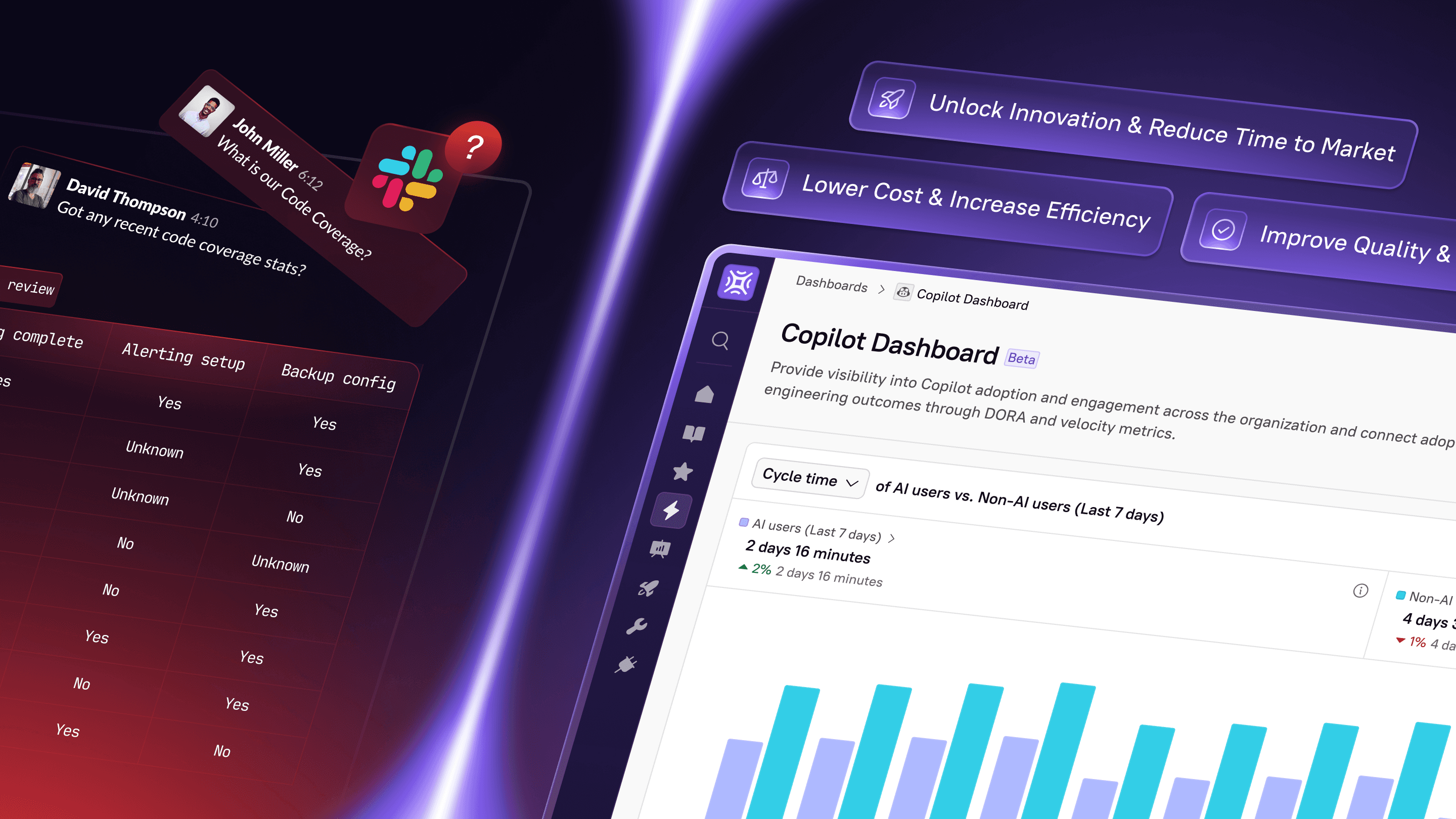
Chris Ramsay, Principal DevOps Engineer at Vista, recently told us how his team uses Cortex to enhance their AI-powered developer experience by integrating system data directly into their internal AI tools "This is one of the coolest things we've built," he continues. "Being able to query Cortex through ChatGPT or Slack and get ownership or repo links instantly is game-changing."
To manage this surge in volume without sacrificing quality, you need a governance layer that scales. An IDP bridges the gap between leadership's strategic goals and the day-to-day reality of shipping code. It gives you the tooling to operationalize this mandate in three specific ways:
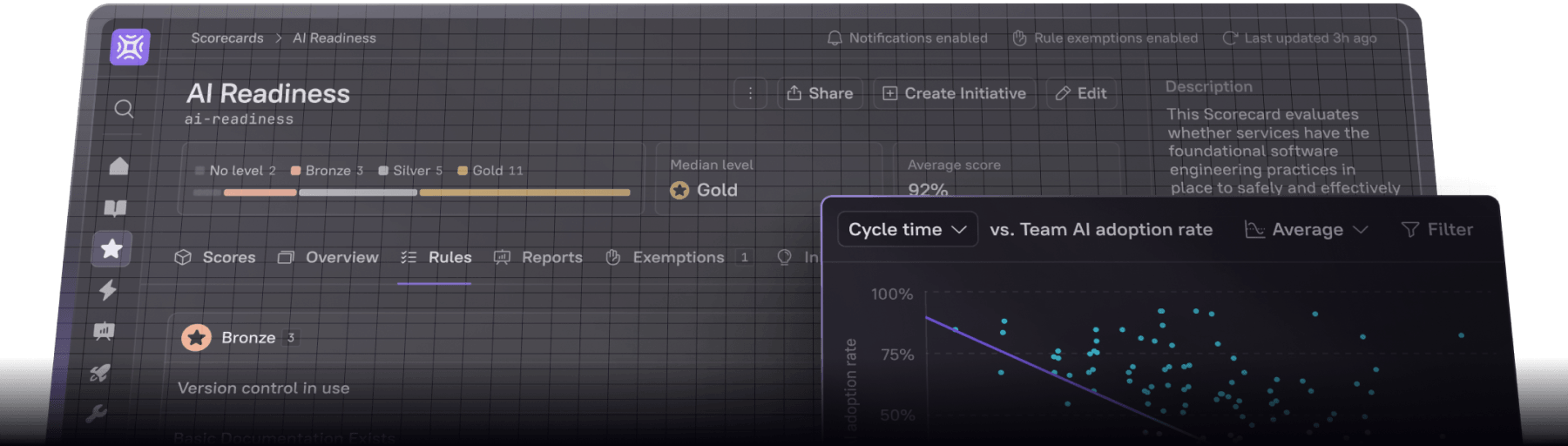
Set the standard. Use Scorecards to track AI readiness and maturity across every service.
Stop guessing about impact. Use data to show which teams have adopted the new AI framework and how it correlates with deployment frequency or incident reduction.
Pave the road. Use Workflows to create "Golden Paths" for AI services, ensuring that every new AI experiment starts with the right security guardrails and infrastructure configurations baked in.
With these workflows in place, the exploration phase is over. Instead of vague promises about the future, you can demonstrate exactly how AI is accelerating velocity today. This makes AI a measurable competitive advantage, whether that's through automated scaffolding or, in Vista's case, letting engineers query their infrastructure using natural language.
Lowering cloud costs and increasing efficiency
It seems as if the permanent state of modern engineering is to figure out how to do more with less. But cutting costs often leads to cutting corners, which eventually leads to technical debt and outages. The goal is to modernize and optimize while managing spend.
For leaders focused on lowering costs, static spreadsheets and wikis often fail to provide the necessary visibility. You need visibility into the live state of your infrastructure. You need to know if your AWS, Google Cloud, or Azure resources are running on the right versions and if they are properly scaled.
Amanda Jackson, Technical Program Manager at Rapid7, says her team finally got this visibility and accelerated a massive modernization effort after implementing Cortex. Her team needed to migrate thousands of services, a task that typically drags on for quarters. With Cortex, they executed it with surgical precision. By pulling directly from resource metadata, Rapid7 identified the right owners and tracked progress in real time.
"We went from what would have been months of work to under two weeks. We could see exactly which instances were left and which teams were responsible." Amanda Jackson — Technical Program Manager, Rapid7
An IDP provides the necessary oversight without the micromanagement that’s often associated with the word “oversight.” It gives you the data to run targeted campaigns that reduce spend and improve reliability across three key areas:
Run targeted campaigns. Create a specific initiative to identify and upgrade legacy infrastructure. Rapid7 migrated 3,000 RDS instances in less than two weeks using this approach.
Flag the waste. Use scorecards to identify services that are over-provisioned or running on deprecated instance types.
Stop the sprawl. When everyone builds differently, maintenance costs explode. By driving teams toward Golden Paths, you reduce the cognitive load and the operational overhead of supporting "snowflake" infrastructure.
Rapid7 proved that visibility is the difference between a migration that drags on for months and one that finishes in days. An IDP makes modernization a standard operational capability rather than a disruption.
Protecting revenue during peak events
For some of the biggest brands on the planet, reliability serves as a critical revenue metric. Downtime during Black Friday represents an existential threat not just to that specific event's success, but to the company's top line goals for the year.
In a recent blog post, Klaviyo CTO Surabhi Gupta recently detailed how her team handled their massive Black Friday Cyber Monday (BFCM) scale in 2025. Surabhi wrote that Cortex was a core part of their strategy, and that they used the platform to systematically track readiness across hundreds of services.
An IDP allows you to run readiness campaigns well before the traffic hits. Instead of sending frantic emails asking whether or not everyone's ready, you can use the platform to enforce standards systematically:
Make readiness a gate, not a checkbox. Enforce meaningful standards that every service must meet before it touches production traffic.
Actually learn from the past. Track incident retrospectives to ensure past failure modes don't repeat.
Know who to page. When an incident does occur, knowing exactly who owns a service reduces the "mean time to innocence" and gets the right people in the room faster.
Reliability creates customer trust, and customer trust drives revenue. By making readiness a visible, trackable metric, reliability becomes a managed business capability rather than a matter of luck.
The platform should create pull
Kaspar von Grünberg, CEO of Humanitec, recently joined Ganesh on a recent episode of the Braintrust podcast, in which he argued that you can't force developers to adopt a platform. Kaspar added that it must create "pull" by being 10x better than the alternative. If you build a platform that makes it easier to ship AI features and safer to deploy before Black Friday, developers will adopt it because it just works.
This is the business case for an IDP. It aligns your engineering resources with the initiatives that matter most to the business while simultaneously improving developer experience.
When you map your IDP to your business goals, the value becomes undeniable. Instead of building shelfware, you build the central nervous system of your engineering strategy.