
This article references Cortex as an Internal Developer Portal (IDP).
The internal developer portal was born out of a thesis that quickly proved to be correct: that developers needed a single place to find documentation, understand service ownership, and navigate complex toolchains. In the time since, many engineering teams have discovered they need more than organized information. They need a platform that orchestrates workflows end to end, enforces standards automatically, and gives engineering leaders the data to act on what they find.
Cortex has been building toward this vision for years, adding capabilities that go well beyond what any portal was originally designed to do. As a result, we've expanded our vision to be an end-to-end Engineering Operations Platform – a far more accurate description of what that work has produced for our customers. It's also a more useful frame for any team thinking seriously about what their internal platform needs to become.
Pragya Jazwal, Platform Engineering Lead at Paxos, compared standing up an internal developer portal to buying a gym membership during her talk at IDPCON 2025. Purchasing the software is one thing, but convincing a team of busy engineers to change their daily habits is a much bigger monster to tame.
Pragya says the platform team at Paxos learned this lesson the hard way. They launched a platform to solve major inefficiencies, such as a service onboarding process that required 14 pull requests and days of waiting. They were excited about what they built and expected developers to embrace the solution immediately. Instead, they saw some really bleak early adoption numbers that led the team to reconsider everything.
When Pragya said the numbers were bleak, she might have undersold it. In the early days, only 40 percent of the engineering organization knew the portal existed. Of those who knew about it, only 30 percent were active users.
Pragya admitted that YAML wasn't exactly the team's love language and that the underlying issue was serious. They had built a functional system that should have solved a lot of major problems, but turned out to be an albatross that nobody wanted to use.

Using scorecards to measure operational readiness
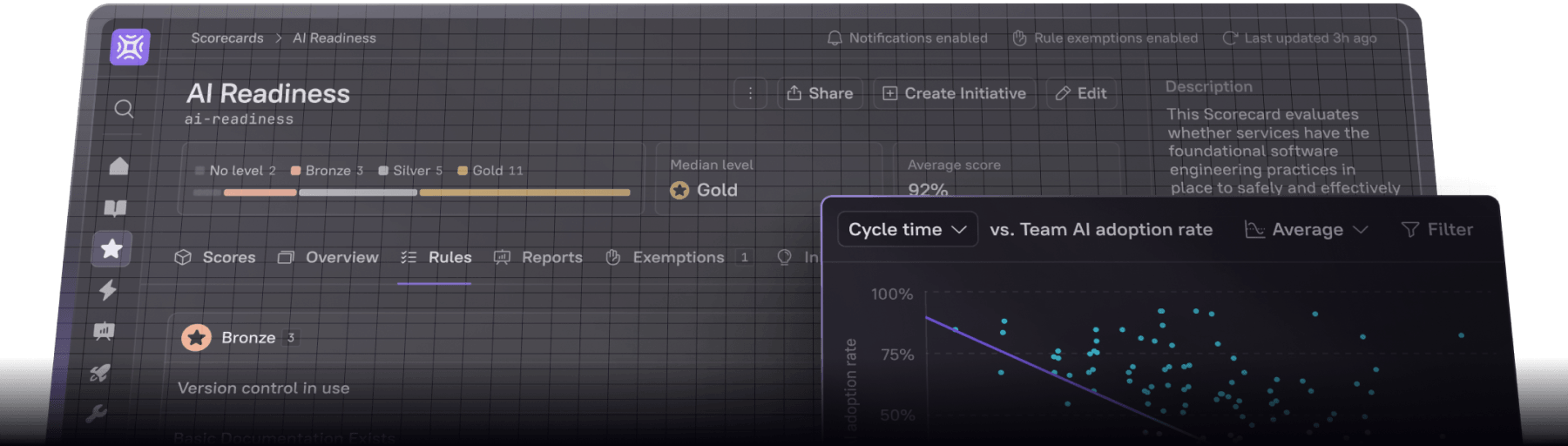
Pragya says one of the biggest points of contention was the scorecard system. While platform engineers love scorecards because they drive standardization and reduce risk, she says developers often loathe them because they feel like a report card.
"Every time my son comes back with a scorecard saying, 'Hey, I'm proud that I got an A,' my first response is, 'Okay, but why not an A+?' I totally understand how developers must feel [when scorecards are used this way]. It's always the judgment that comes across, and not the encouragement [they need to write great code]." — Pragya Jazwal, Platform Engineering Lead, Paxos
Paxos realized they needed to change the narrative. They stopped positioning scorecards as a compliance tool or a "wall of shame." Instead, they rebranded them as dashboards for operational readiness. This shift in language helped developers see the metrics as a tool for sleeping better at night rather than a tool for management oversight.
Your IDP is not (and shouldn't be) one-size-fits-all
Pragya says it didn't take long for the team to realize their initial rollout was built under the assumption that a single workflow would work for everyone.
She says this approach ultimately failed because different teams have different needs. A Site Reliability Engineer needs deep visibility into infrastructure, while a product engineer just wants to ship code without breaking anything.
"Think about [what it'd be like] to roll out a one-size-fits-all shoe. If I give a shoe that is of the same size to all of you, nobody's going to be happy and everybody's going to walk funny. So that's not going to work." — Pragya Jazwal, Platform Engineering Lead, Paxos
Paxos pivoted by identifying primary personas and building workflows specifically for them. They also focused on high-impact use cases like scaffolding, which solved an immediate pain point for teams launching new services.
Reducing friction is the only internal marketing that matters
You can send as many emails as you want, but adoption ultimately comes down to utility. If the portal does not save time, developers will not use it.
"Until the portal delivers real dramatic improvement, developers revert to familiar workflows." — Pragya Jazwal, Platform Engineering Lead, Paxos
Paxos focused on making the portal actionable. They provided direct links and one-click fixes for issues flagged in the scorecards. They integrated the portal into daily workflows so that using it felt natural rather than forced.
They also started celebrating wins. Instead of just flagging problems, they highlighted teams that improved their service health in town halls. They made good platform hygiene a status symbol.
How Paxos is evolving with its product-first mindset
The shift from a mandate to a product mindset changed everything for Paxos. Today, 100 percent of their engineering organization is aware of the portal. Active usage has climbed to 70 percent.
For Pragya, the lesson is that platform adoption is a change management problem for leaders to solve. She argues that you can't code your way out of a culture that doesn't trust the tools. You have to build a product that solves a real problem, market it to the right audience, and remove every bit of friction that stands in their way.
Watch this and all the talks from IDPCON 2025 to hear more from Pragya Jazwal and other engineering leaders. To learn more about an IDP that engineers love to use, book some time with us to see Cortex in action.