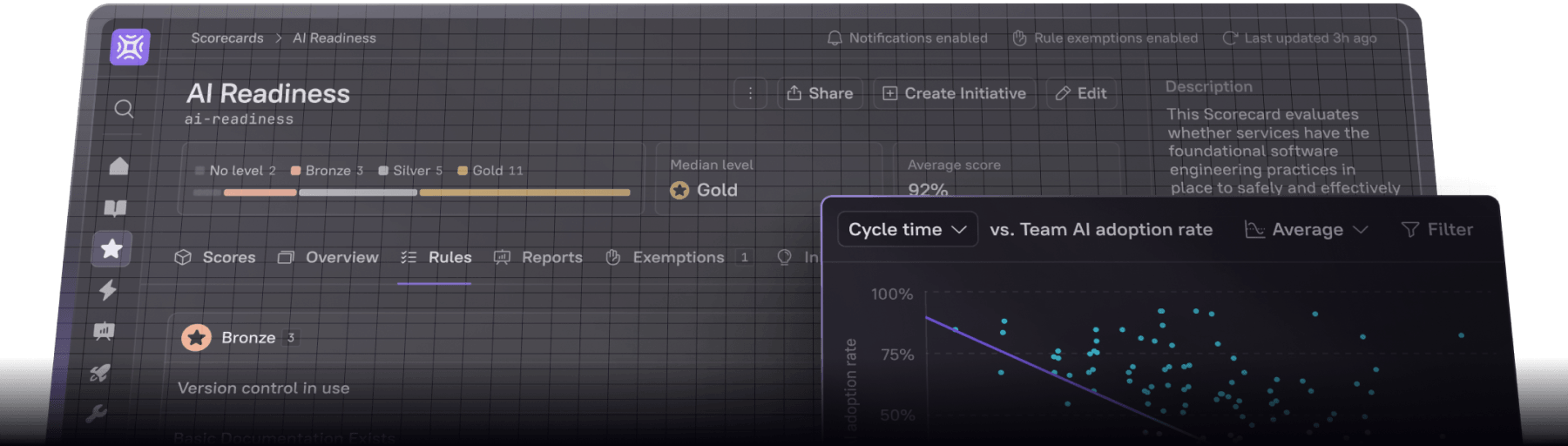

As a baseline, engineering leaders need their teams to adopt AI tools to speed up velocity and ship faster. Most organizations have already rolled out AI coding assistants or are evaluating them, but there's a really big difference between buying a tool and successfully scaling it across an engineering organization.
If you layer AI on top of a chaotic codebase or a disorganized service catalog, you accelerate the creation of legacy code. Before looking ahead to scaling AI strategies for 2026, it's really important to take a closer look at what your data is actually telling you.
AI models are only as good as the context you give them. You need a solid operational baseline to get real value out of these tools and ensure they don't hallucinate or break production. Here are the four foundations you need to establish before you can effectively scale AI in your engineering org.
1. Understand your ecosystem
You can't automate what you can't see. The first foundation of AI readiness is having a comprehensive, accurate inventory of everything that exists in your ecosystem.
A simple list of repos isn't enough. You need a single pane of glass that shows you every service, resource, and library, along with the infrastructure from your cloud providers. You also need to map the dependencies between them. When an AI agent attempts to navigate your codebase, it needs to understand the complete data model linking your services to the underlying infrastructure. If your service catalog is fragmented or outdated, the AI lacks the necessary map to navigate your architecture. Establishing a "golden record" of your services ensures that both your developers and your AI tools work from the same source of truth.
2. Contact and communication
Once you know what services and infrastructure exist, you need to know who is responsible for them. This sounds basic, almost rudimentary, but service ownership often gets lost in high-growth organizations where reorgs happen annually.
We recommend a service-first model rather than a team-first model because even as teams change, services usually stick around. Most, if not all, engineering leaders have experienced that post-reorg fog where you’re trying to figure out if the billing service moved to the new platform team or stayed behind. When you map ownership, on-call rotations, and Slack channels directly to the service, you insulate your catalog from that chaos. Instead of manually updating records while the dust settles, Cortex handles this for you through your integrations, ensuring your ownership data updates automatically as your teams evolve.
This is critical for AI adoption for two reasons. First, when an AI tool suggests a change or flags an issue, it needs to know where to route that information. Second, if you use AI to generate code or refactor legacy systems, you need a clear chain of command for code review and approval. Ownership reports and scorecards help you audit this data to ensure every piece of software has a reachable human owner.
3. Documentation and context
We often think of documentation as a chore for humans, but it has become the primary textbook for our AI tools.
For an AI to generate code that adheres to your standards, it needs clear instructions. This means your README files, contribution guidelines, and architectural decisions need to be up to date. If your documentation is sparse or contradicts your actual code, the AI will guess, and it will often guess wrong.
Good documentation is now a functional requirement for tooling. You should treat your internal docs as prompt engineering at scale. By embedding clear instructions and best practices directly in your repositories, you provide the context window the AI needs to be a helpful assistant.
4. Guardrails and monitoring
The promise of AI is speed, but speed without brakes is dangerous. If AI helps your team ship 50% more code, you need to be 100% sure your monitoring can handle the increased throughput.
Before scaling AI, you also need to ensure your production readiness is airtight. This means defining Service Level Objectives (SLOs), setting up robust monitors, and ensuring your alerting pipelines are functional.
When something goes wrong (and it will), you need the ability to detect it immediately. AI can write code, but it cannot yet fully intuit the operational impact of that code in a complex distributed system. Your monitoring suite acts as the guardrail that allows you to move fast without breaking trust with your customers.
Preparing for 2026 and beyond
Adopting AI goes beyond the tools you buy today. It requires preparing your infrastructure for the autonomous agents of tomorrow.
By focusing on visibility, ownership, documentation, and guardrails, you build the necessary structure to let AI drive real value. Whether you use Scorecards to track adoption or Workflows to enforce standards, the goal is the same. You want to build a platform where AI accelerates your best engineering practices instead of amplifying your worst ones.
Book a demo with Cortex today to learn how you can build a better foundation for AI.