
Though AI tools have made individual developers dramatically more productive at writing code, most engineering organizations report moving only about 20% faster than before. As Honeycomb CTO Charity Majors recently wrote, "AI came for code generation first because it was the easiest problem to solve, but it was never the thing holding developers back."
The bottlenecks are, in fact, operational. When an incident fires, on-call teams scramble to figure out who owns the service. A migration stalls because there's no reliable way to track which teams have finished it. A new engineer spends two weeks reconstructing context that should have been documented and easily accessible. Standards get defined in a kickoff meeting and drift quietly for six months until someone hits the same problem the standard was written to prevent. Many teams are discovering that writing code faster in a broken operational environment doesn't make the environment less broken.
That's also why so many of those teams are turning to Engineering Operations (EngOps) platforms to fix those operational challenges. Here's what they are, how they differ from the internal developer portals that came before them, who uses them, and what to look for when selecting one.
What is Engineering Operations?
Engineering Operations (EngOps) is the discipline of systematically improving how an engineering organization delivers software, above the level of individual code changes and deployments.
Every other major function in a company has an operational counterpart. Sales has RevOps, marketing has Marketing Ops, and finance has FP&A. These functions exist because the work of running a department well is different from the work that department produces, and important enough to own explicitly. Engineering, despite being the largest cost center at most technology companies, has historically lacked one. Instead, the responsibilities get split across Platform Engineering, SRE, DevEx, DevOps, and Security, each team largely operating in its own silo, with no shared view of organizational health.
EngOps owns the connective tissue, which includes service ownership, catalog accuracy, standards enforcement, migration tracking, engineering intelligence, and developer onboarding and self-service. None of these are new problems. What is new, however, is the approach of treating them as a unified discipline rather than ad hoc responsibilities distributed across teams whose primary missions are something else.
What is an EngOps platform?
An EngOps platform is software that gives engineering leaders and platform teams a live, accurate picture of how their engineering organization is running, including who owns which services, whether those services meet the organization's standards, where improvement programs are stalling, and which teams need attention. All of this data is updated automatically via robust integrations with the engineering tech stack, versus the outdated method of being maintained by hand.
A platform is what makes EngOps tractable at scale. At fifty engineers, an experienced engineering leader can probably keep a running tab of what's going on across the org in their head. At five hundred engineers spread across dozens of teams and hundreds of services, that "model" collapses. The data an EngOps function needs to do its job is scattered across ten different tools, from service ownership, standards compliance, deployment health, and incident patterns, creating a jumbled picture (or none at all) of the health of the organization. Without an EngOps platform, left scrambling manually stitching these data sources together, only for it to become outdated as soon as it’s created.
What's the difference between an EngOps platform and an IDP?
Internal Developer Portals (IDPs) give developers a single interface to find information about services, infrastructure, and tooling. That's genuinely useful. But an IDP's output is a view, and it doesn't act on what it sees.
An EngOps platform offers the same functionality as an advanced IDP, like service catalogs that map ownership across the org, and developer self-service workflows that let engineers provision infrastructure and spin up new services without waiting on platform teams. But it doesn't stop there.
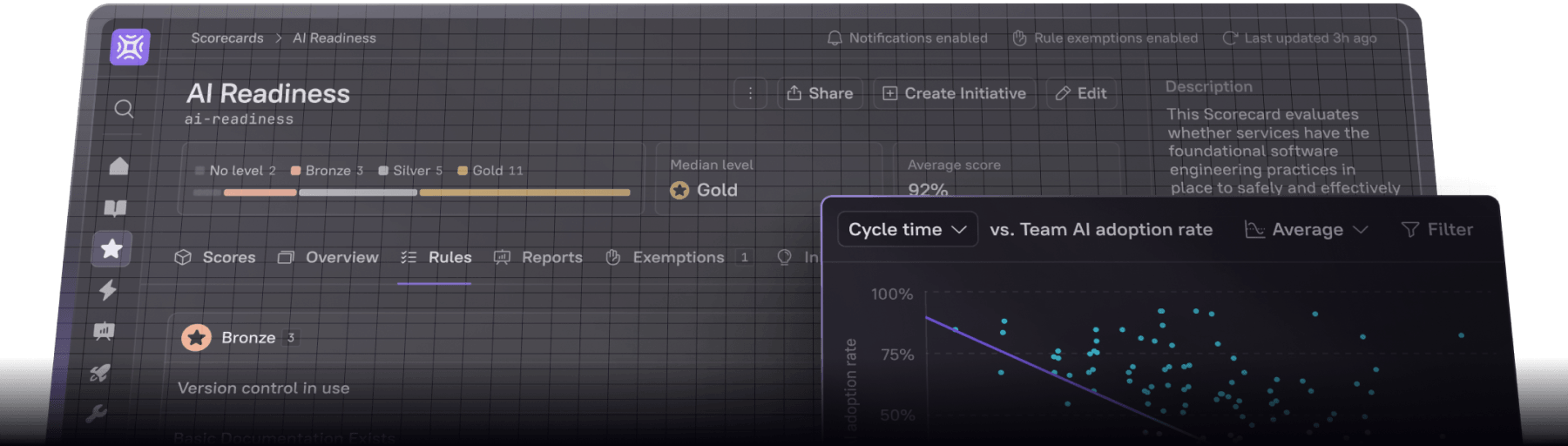
Where an IDP gives you a view, an EngOps platform gives you accountability. Scorecards let you define what a healthy service looks like and track every team's progress against it automatically. Initiatives take those measurements and turn them into org-wide improvement programs with owners, deadlines, and automatic progress rollup so standards don't stall at 50% adoption. Engineering Intelligence surfaces DORA metrics, production readiness signals, and security posture across hundreds of services in real time. And the Context Graph maps how services, teams, and dependencies connect to each other, which matters most when something breaks and you need to know the blast radius immediately.
Key features of an EngOps platform
Not every tool that calls itself an EngOps platform has the same capabilities, but the strongest ones share a common set of features that work together rather than in isolation. A catalog without scorecards gives you visibility with no accountability. Scorecards without initiatives give you measurement with no follow-through. The features below are most valuable when they reinforce each other.
Integrations
An EngOps platform doesn't replace your toolchain. It connects it. Deep integrations with GitHub, GitLab, AWS, GCP, Azure, PagerDuty, Datadog, Jira, Snyk, and dozens of other tools mean the catalog and scorecard data reflects what's actually happening in your systems, not what someone last updated in a spreadsheet.
Catalog
A good EngOps platform automatically syncs with your existing toolchain (think GitHub, AWS, PagerDuty, Jira, and the rest of the tools your engineering team uses) to maintain a live record of every service, team, and dependency in your organization. Every service has a clear owner, dependencies are mapped, and the data doesn't go stale because it's pulled from systems of record. If service ownership is currently murky in your org, the catalog is how you fix it.
When an incident hits, when you're onboarding a new engineer, or when you need to know whether a third-party dependency is used anywhere critical, the catalog is where you start.
Engineering Intelligence
Engineering Intelligence tells leaders not just what's happening, but why and where the gaps are concentrated. It pulls in DORA metrics, production readiness signals, security posture, on-call health, and trend data that reveals systemic patterns across hundreds of services.
Scorecards
Scorecards enforce standards without making enforcement someone's full-time job. You define what "good" looks like. That definition includes everything from production readiness, security posture, on-call hygiene, documentation completeness, and AI readiness. Then, the platform measures every service against those criteria automatically.
Leaders see where standards are holding and where they're slipping. More importantly, teams get specific, actionable feedback about what to fix.
Initiatives
Standards stall at 50% adoption without follow-through. Initiatives give engineering leaders a structured way to run org-wide programs such as a library migration, a security remediation sweep, a reliability push with clear ownership, deadlines, and automatic progress rollup.
A single Initiative view shows what's moving, what's blocked, and who needs a nudge without anyone assembling a status report.
Developer self-service
Self-service reduces friction for developers without creating a bottleneck for platform teams. Golden path workflows, scaffolding templates, and pre-approved configurations let engineers spin up new services, provision infrastructure, or trigger workflows without waiting on manual approvals.
Every new service that starts from a golden path template begins with the right ownership metadata, monitoring configuration, documentation structure, and security defaults already in place, compliant from the start.
Context Graph
The Context Graph maps which services depend on which, which teams own which components, and which infrastructure resources back which applications. During an incident, that map tells you the blast radius of a change and the ownership chain to call — before you spend twenty minutes figuring it out manually.
Cortex MCP
The Cortex MCP server connects your engineering catalog and health data to AI coding agents and developer tools. Developers can ask questions about ownership, dependencies, and service health directly in their IDE without leaving the editor to look it up.
Who uses an EngOps platform?
The short answer is everyone in the engineering organization, but for very different reasons. Leadership uses it to see across teams without manual reporting. Platform teams use it to set and enforce standards without becoming a bottleneck. Developers use it to find what they need without asking someone.
Here’s a more detailed list of who uses an EngOps platform, and more importantly, why they need one.
Engineering leaders such as CTOs, VPs of Engineering, Directors use it to get an accurate picture of organizational health without relying on manual reporting. They use Scorecards and Engineering Intelligence to identify where standards are slipping, track org-wide initiative progress, and make resource decisions backed by actual data.
Platform teams use it to drive adoption of standards across dozens or hundreds of teams without becoming a bottleneck. Instead of fielding the same questions repeatedly, they build golden paths and self-service workflows that make good practice the default.
Developers use it to find ownership information, runbooks, dependency maps, and documentation without digging through wikis or pinging colleagues.
SRE and reliability teams use it to manage production readiness standards across the org, track on-call hygiene, and ensure every service that reaches production meets a defined reliability baseline. The catalog and Context Graph are essential during incidents, when knowing service dependencies and ownership immediately can be the difference between a fast recovery and a long outage.
Technical Program Managers (TPMs) use it to track migrations, compliance initiatives, and platform rollouts across multiple teams in real time, without assembling progress reports by hand.
Security teams use it to continuously monitor services against security standards, flag vulnerabilities, and track compliance at the service level — not just at audit time. The EngOps platform turns security compliance from a point-in-time audit into an ongoing signal.
Key use cases for an EngOps platform
The use cases where EngOps platforms deliver the clearest value tend to solve problems that are manageable at small scale and become genuinely expensive once you have enough services and teams that manual coordination stops working. The four below represent where most organizations start.
Production readiness
Define what it means for a service to be production-ready, runbooks, on-call coverage, alerting configuration, test coverage, dependency documentation, and measure every service against that definition automatically. Catch gaps before a release rather than discovering them during an incident.
Modernization and migrations
A framework upgrade or cloud migration across hundreds of services is fundamentally a coordination problem. (For a deeper look at what that coordination actually requires, see how to successfully run a migration.) An EngOps platform tracks which services have completed the work and which are lagging, routes tasks to the right owners, and gives leadership a real-time progress view without anyone maintaining it by hand.
Remove developer friction
Reduce the ticket queue for platform teams by giving developers pre-approved paths to provision infrastructure, spin up new services, or trigger operational workflows. The platform enforces organizational standards in the background so developers move fast without creating technical debt or compliance exposure.
Compliance and audits
Continuously monitor service-level compliance with security policies, documentation requirements, and organizational standards. When audit time comes, the evidence is already there, not something that has to be assembled in the week before the deadline.
Best practices for getting value from an EngOps platform
Most EngOps platform deployments stall because teams try to do too much at once, or they skip the foundational work and build on data they don't fully trust. These five practices are roughly sequential, but each one makes the next one more effective.
Start with your catalog. Every other feature in the platform is only as reliable as the data behind it. Get your integrations connected and ownership defined before building out Scorecards or Initiatives.
Define "good" before you measure. Scorecards only work when there's a clear, agreed-upon definition of what a healthy service looks like. Start with your most important standards — production readiness, security baseline, on-call coverage — and make the criteria specific enough to act on.
Connect measurement to improvement workflows. A gap without an owner doesn't get fixed. Pair Scorecards with Initiatives so that when a standard is failing, there's a clear owner and a deadline attached.
Make self-service the default for new services. Every new service that starts from a golden path template is compliant from the jump. Fix the source, not the symptoms.
Use integrations to keep data fresh automatically. Any standard that relies on someone updating a spreadsheet will erode. Connect your source systems and let the platform pull the data.
How Cortex powers engineering operations
Cortex is an Engineering Operations platform built for the entire engineering organization, whether you're a CTO setting direction, an SRE managing reliability, a platform engineer building internal tooling, a TPM running migrations, or a developer trying to find out who owns a service.
With Cortex, teams can:
Maintain a live, accurate service catalog that maps every service, team, and dependency automatically
Raise the bar with Scorecards that define what "good" looks like and track every team's progress without manual reporting
Drive org-wide programs with Initiatives that assign owners, set deadlines, and surface progress to leadership automatically
Get Engineering Intelligence, DORA metrics, production readiness signals, security posture, and on-call health, in real time
Enable developer self-service with golden path workflows and scaffolding that make compliant behavior the default
Connect AI tools to your engineering catalog via the Cortex MCP server, so developers get accurate context about ownership and dependencies without leaving their IDE
Book a demo to see how Cortex fits into your engineering operations practice.