
Every engineering team wants to ship high-quality, reliable software quickly. Historically, engineers used a few guiding principles to help them consistently write clean code: keep code DRY, shift security left, write solid test cases, own your services, document your runbooks, and more. What most teams learn the hard way, however, is that those principles only go so far when headcount triples, a dozen microservices get spun up in a quarter, and the only engineer who understood the auth service leaves for another company.
Now add AI-assisted development to the mix. Engineers are generating code faster than ever: spinning up services, scaffolding infrastructure, and shipping features at a pace that would have been unthinkable two years ago. That acceleration is a massive unlock, but it also amplifies every gap in your standards. When a single developer can produce in a day what used to take a week, the volume of code that needs to meet your security, reliability, and operational standards grows proportionally. Without guardrails, AI-generated code becomes another vector for inconsistency, tech debt, and production risk, just at higher velocity.
Even with a deep understanding of these widely-accepted principles, engineering teams often discover that there's a big difference between knowing the standards and applying them, especially as tech debt accumulates, incidents spike, and velocity suddenly comes to a screeching halt. The informal processes that once kept engineers on the same page stop working at scale, like unspoken rules for resource allocation standards or which monitors & SLOs to watch during a deployment to ensure there are no issues. Without a structured way to observe, measure, and enforce standards across the codebase, it becomes virtually impossible to ship quality products.
This article covers what software development standards are and why they matter, why they tend to break down in practice, and what it takes to enforce them across a growing organization.
What are software development standards and why do they matter?
Software development standards are the rules, principles, and practices that define how software is built, reviewed, deployed, and maintained across a team or organization. They cover how code is written, how services are owned, how security is reviewed, and how new services get created.
The goal isn't uniformity for its own sake. Standards exist to reduce the cost of building and maintaining software over time by making codebases easier to understand, reducing duplicated work, cutting down on incidents caused by configuration drift, and getting new engineers productive faster. Teams that operate without standards don't always notice immediately. Technical debt accumulates quietly, ownership gets murky, and the codebase becomes the kind of thing that's easier to work around than to understand. The cost usually becomes visible through increased incidents, slow onboarding, or a team that's constantly reacting instead of building.
Principles of code quality and maintainability
The foundational principles of code quality have been stable for decades. DRY (Don't Repeat Yourself) reduces the cost of change by ensuring logic lives in one place. KISS (Keep It Simple, Stupid) limits unnecessary complexity. YAGNI (You Aren't Gonna Need It) discourages building for hypothetical futures at the expense of the problem in front of you.
These principles aren't controversial. What's difficult is enforcing them consistently when teams are large, under delivery pressure, and half the codebase was written by someone who no longer works there.
Version control and rigorous testing
Git has become the universal standard for collaborative development. Version control gives teams a reliable record of changes, supports code review workflows, and makes it possible to recover from mistakes. The practices built around Git such as branching strategies, commit hygiene, PR review norms are as important as the tool itself.
Testing is where "shift left" becomes more than a slogan. Teams that catch issues in development rather than production pay a much lower cost for quality. Automated test suites, continuous integration, and clear coverage expectations are the mechanisms that make this concrete. They're also the standards most likely to erode under deadline pressure. Skipping a flaky test can save time today, but it will usually show up weeks later as an incident someone else has to debug.
The Agile and DevOps framework
Agile and DevOps have become the default operating model for most modern engineering teams. Iterative development, cross-functional collaboration, and continuous delivery mean code ships faster, which raises the stakes for maintaining quality at every stage.
DevSecOps extends the DevOps model further by making security a first-class concern throughout the development lifecycle, rather than a gate at the end. As teams move faster, security can't be a bottleneck. It has to be built in.
The scaling challenge: why standards break down in practice
The principles above aren't hard to understand, but sustaining them at scale remains a huge challenge for many engineering teams. As organizations grow and architectures become more complex, the informal processes that once kept things coherent stop working.
Fragmented tooling and tribal knowledge
In smaller teams, critical context lives in people's heads and survives handoffs through direct communication. At scale, that model collapses. Service ownership gets murky. Dependencies go undocumented. The engineer who understood why a particular configuration decision was made isn't on the incident call at 2 a.m.
When that knowledge is scattered across wikis, spreadsheets, Slack threads, and individual laptops, the cost of every incident, every onboarding, and every architecture review goes up. Teams spend time rediscovering what should already be known.
Checklist culture vs. true accountability
Standards for production readiness, security review, or service maturity often get operationalized as manual checklists. Someone fills them out before a launch. Nobody verifies the answers.
The problem is that without automated verification and tracking, there's no real visibility into whether standards are being met or where the gaps are. What gets measured gets managed, and what gets manually reported gets gamed.
Entropy and drifting standards
Even organizations that start with clear standards find that those standards erode over time. Teams under deadline pressure make pragmatic exceptions that quietly become the new normal. New services get created without following established templates. Security policies that applied to the old stack don't clearly extend to the new one.
Each deviation makes the next one more acceptable. Over time, the organization accumulates layers of inconsistency that shows up as incidents, security exposure, and slower onboarding, which is incredibly expensive and difficult to unwind.
Best practices for enforcing development standards at scale
Defining standards is the easy part. Embedding them into how an organization actually works is the challenge. The following practices separate standards that hold under pressure from standards that exist only on paper.
Prioritize visibility into service ownership and maturity
Before you can enforce a standard, you need to know the current state. That means having a single, reliable source of truth for your service landscape — who owns each service, what dependencies it has, whether it has a runbook, whether it has on-call coverage, and where it stands against your organization's definition of production-ready.
Without that visibility, standards conversations happen in the abstract. With it, they become concrete and trackable.
Automate checks and feedback loops
The most durable standards are the ones engineers don't have to consciously remember to follow. Automated checks in CI pipelines, deployment gates, and scheduled reports surface violations before they become problems without requiring manual effort.
Automation also changes the accountability dynamic. When a service is flagged for missing coverage or a stale runbook, the conversation becomes less about why someone didn't follow a standard and a more productive version of that chat about what needs to be fixed.
Shift standards left with consistent scaffolding
The easiest time to enforce a standard is before the code is written. Service scaffolding and templates ensure every new service starts with the right configuration, ownership metadata, monitoring setup, and documentation structure already in place. That eliminates an entire category of standards drift before it starts.
Teams that invest in consistent scaffolding find that onboarding gets faster and new services are production-ready by default rather than by exception.
Make adherence measurable and visible
Standards need metrics, not because metrics are the goal, but because without a way to measure adherence, there's no mechanism for identifying where gaps are concentrated, tracking progress over time, or holding teams accountable in a way that's fair and consistent.
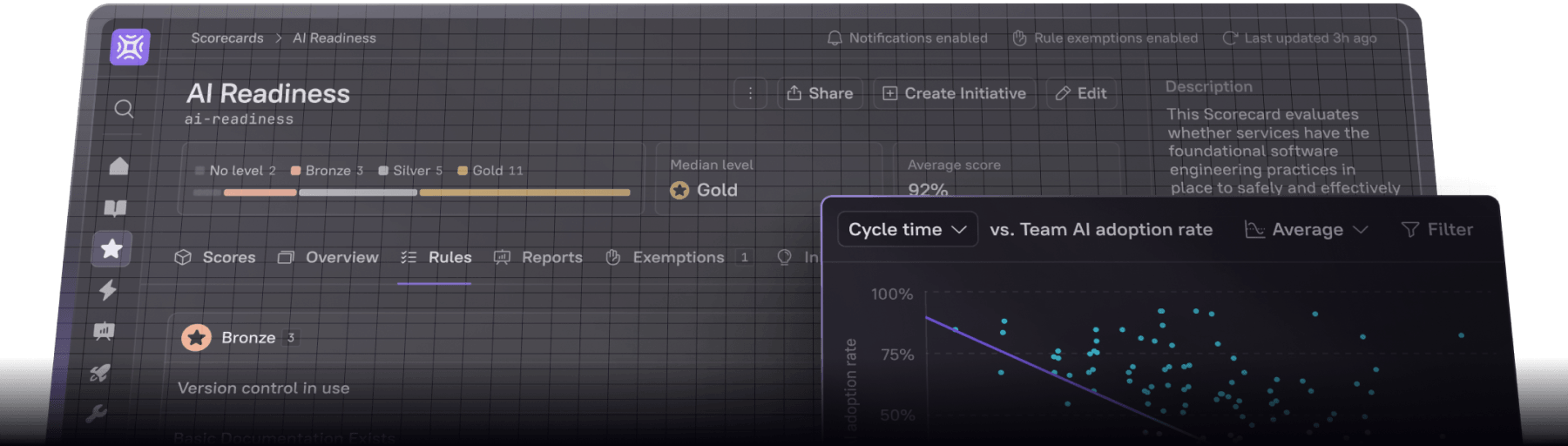
Scorecards are one effective approach: defining what "good" looks like across a set of criteria ( e.g. documentation, monitoring, security posture, test coverage) and measuring each service against those criteria automatically. The score becomes a shared language for quality across the organization.
Adopt an engineering operations platform
All of the above becomes significantly more tractable with an engineering operations platform that centralizes service data, ownership, standards tracking, and scaffolding in one place. Without a platform, teams stitch together point solutions that rarely integrate well and don't give leadership a coherent picture.
An engineering operations platform isn't about arbitrarily adding processes. It's about improving operational maturity and removing the friction that makes standards hard to follow and easy to ignore.
The future of standards in an AI-powered world
AI-assisted coding is changing the volume and velocity of software production. Engineers using tools like GitHub Copilot can generate code, write tests, and spin up new services faster than ever. That speed is genuinely useful.
However, it also creates a new governance challenge. AI-generated code still needs to meet your organization's standards for quality, security, and compliance and the pace at which it's produced means those checks can't rely on the same manual review patterns that worked when engineers wrote every line themselves.
AI tools often generate unit tests alongside code, but those tests validate behavior the model inferred, not necessarily what the system actually requires. That makes test coverage a less reliable quality signal than it once was, and makes the code review one of the remaining checkpoints where a human has to verify that generated code actually does what the system needs.
As AI adoption speeds up, governance layers must strengthen to ensure standards are being met. Automated scorecards, service scaffolding, and consistent ownership practices are exactly the infrastructure that makes it safe for engineering teams to move faster without increasing operational risk.
How Cortex helps teams enforce standards
The difference between high-performing engineering organizations and average ones isn't knowing the right standards. Most teams already know what good looks like. The difference is leveraging a system that makes good the default.
Now, more than ever, upholding engineering standards is a differentiator and force multiplier. With Cortex, teams can:
Create a single source of truth for services, ownership, and dependencies so everyone knows who owns what, what's running, and what state it's in
Track progress against org-wide standards with automated Scorecards that measure every service against your definition of production-ready
Enforce standards from day one with service scaffolding and templates that make correct configuration the default, not the exception
Foster a culture of accountability with real-time visibility and dashboards that give leadership a clear picture of where standards are holding and where they're slipping
Teams like H&R Block used Cortex to reduce MTTR by 75% and completely eliminate manual reporting for program managers, so teams could spend more time improving the systems themselves.
Book a demo to see how Cortex fits into your engineering standards practice, or try it for free.