
Engineering leaders often find themselves managing internal tools that have outgrown their original scope. What begins as a simple effort to organize services can quickly evolve into a full-time maintenance job for a team of talented engineers. This is an especially common story for organizations that have spent months trying to build a production-ready portal on top of Backstage.
Internal Developer Portals (IDPs) help organizations centralize access to tools, automate workflows, and provide visibility into software delivery processes through a single interface. By 2028, 85% of platform engineering teams will provide IDPs to accelerate product innovation and improve developer experience, according to Gartner's Market Guide for Internal Developer Portals. While many teams start their journey with Backstage, they quickly find themselves at a crossroads.
Backstage is the most recognized open-source portal framework, but the key word is "framework." It’s not a complete product that works out of the box. Many engineering leaders find that building a production-ready portal on top of a framework requires significant engineering investment and ongoing maintenance that distracts from their core business goals.
If your team is struggling to see the promised ROI from a homegrown portal, it might be time to consider a managed alternative.
How Backstage falls short as an IDP
Backstage introduces a heavy implementation burden almost immediately after a team decides to implement it. Most organizations need two or three full-time engineers working for six months or more just to stand up a basic service catalog. This effort doesn't end after the initial launch. Teams must continue to build and maintain plugins, manage integrations, and handle custom features.
Tyler Davis, a software engineer at Canva, recently joined the Braintrust podcast to discuss the team’s experience building a homegrown catalog on Backstage. Tyler says that it didn't take long for the team to realize they could get more value from the applications they could build on top of a catalog, rather than the catalog itself.
"Unless you're a company named Cortex, you probably don't want to be spending your time building an IDP. That's probably not what your real product is." — Tyler Davis, Software Engineer, Canva
A framework gives you the pieces to build a portal, but a product like Cortex gives you a portal that is ready to use. This distinction is why many leaders are now looking for alternatives that deliver immediate value.
Cortex is the enterprise-ready IDP
Cortex is a fully managed platform designed for rapid deployment and organization-wide adoption. It eliminates the implementation complexity of frameworks while delivering a comprehensive suite of features out of the box.
Several key benefits make Cortex a strong choice for many teams, including:
Production-ready deployment in weeks. Built-in integrations enable you to connect your existing stack and see a complete picture of your architecture in days.
Automatic updates and zero maintenance. As a fully managed solution, Cortex handles all infrastructure management and updates, allowing your platform team to focus on high-impact initiatives.
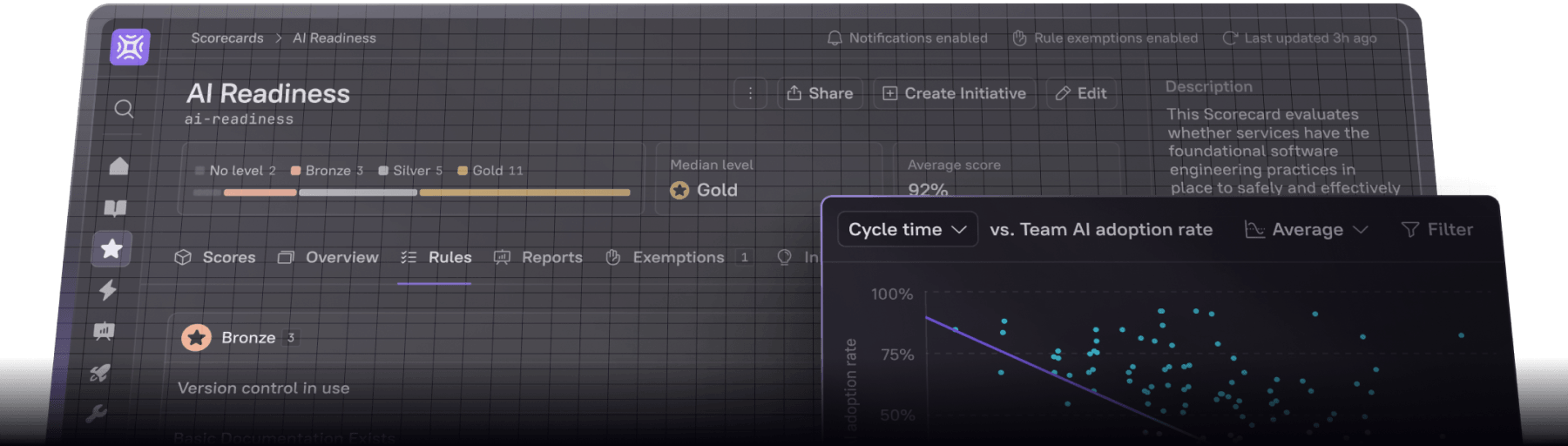
Native engineering intelligence. Cortex provides executive reporting and scorecards that measure service maturity, reliability, and security without requiring custom development.
Driven by developer joy. Features like personalized homepages and proactive alerts give engineers a compelling reason to return to the portal regularly.
For organizations that prioritize time-to-value and executive visibility, Cortex serves as the clear leader in the managed portal space.
Other notable alternatives to Backstage
While Cortex provides the most comprehensive feature set for enterprise organizations, other alternatives focus on specific organizational needs.
Port
Port is a visual, no-code platform that allows teams to build customized developer experiences through flexible data models. It’s a good option for organizations with highly specific workflow requirements that do not fit standard patterns. However, the visual builders can become complex to manage as enterprise needs scale.
OpsLevel
OpsLevel focuses primarily on service ownership and operational maturity. It provides detailed service cataloging and scorecarding systems that are particularly useful for SRE and operations teams. While it excels at ownership tracking, it offers fewer self-service capabilities and organizational insights than a comprehensive platform.
The path to a painless migration
One of the biggest obstacles to moving away from Backstage is the fear of losing existing progress. However, moving to a managed platform is often simpler than maintaining a framework.
Many organizations find that they can ingest their existing Backstage data into Cortex with minimal effort. This allows teams to preserve their service metadata while immediately gaining access to advanced features like automated scorecards and engineering intelligence.
Moving away from a custom built solution often triggers a predictable executive anxiety driven by a sunken cost fallacy. But companies like Canva don't consider this shift an admission of failure. Instead, Tyler describes it as a strategic reclassification of their initial investment.
"We didn't waste our time. We built something that we used and we got value out of it while we were using it. I definitely think that we had a lot of hard-earned lessons that we still keep with us." — Tyler Davis, Software Engineer, Canva
Break up with Backstage today
The internal developer portal market has matured beyond the early days of DIY frameworks. If your portal has become a static directory rather than a dynamic tool for your developers, this is an ideal time to consider a change.
To get started, you can explore our dedicated resources for teams looking to migrate from Backstage. This library provides a clear path for moving your data and scaling your platform without the engineering overhead.
Want to read more migration stories like Canva’s? Check out how they and several others have successfully broken up with Backstage.