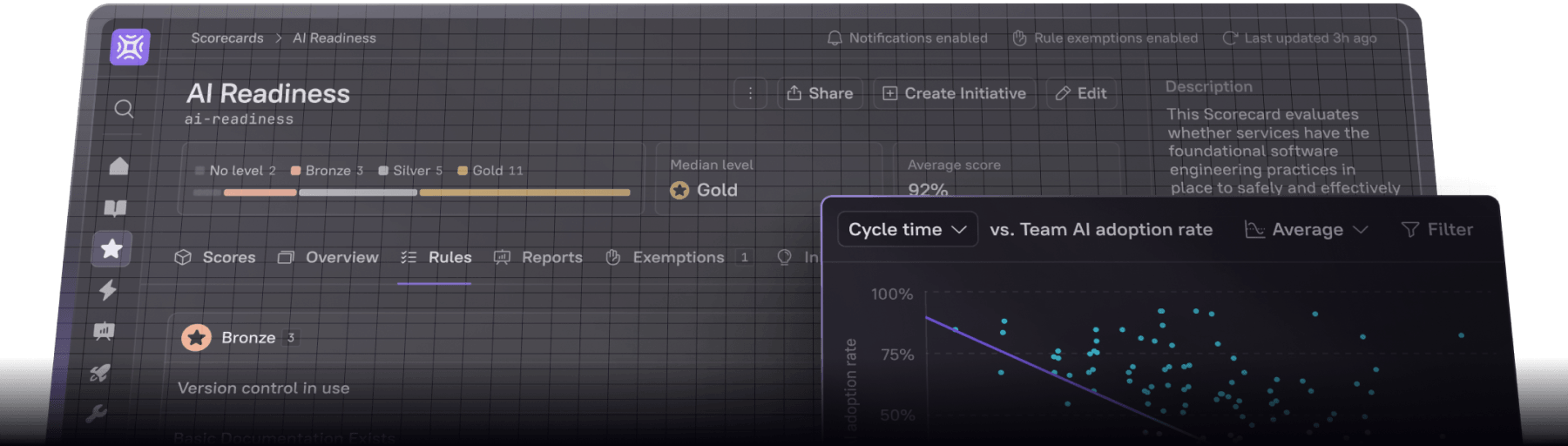

These days, engineering leaders find themselves caught between a rock and a hard place. On paper, AI adoption looks like an unqualified success. Developers are shipping more code faster than ever, pull request volumes are up, and teams report feeling more productive. Their leaders rush to LinkedIn to share their plans to scale adoption because their teams are just so much more efficient.
But then, the incidents and bug reports start piling up. For much of 2025, engineering leaders watched this happen and struggled to get a clear explanation from anyone about why it was happening. This is just one reason we set out to quantify what's actually going on with AI adoption in our 2026 Engineering in the Age of AI report.
The data confirms widely-held concerns that teams are moving faster, but that they’re also breaking things more often and taking longer to fix them. AI coding assistants delivered a 20% increase in PRs per author, but incidents per pull request jumped 23.5% and change failure rates increased 30%.
At the core of these concerns is a governance gap that’s much wider than many leaders realized. While nearly 90% of engineering leaders say their teams actively use AI tools, only 32% have formal governance policies in place. As many teams have discovered, this is the formula for increasing speed and chaos in any engineering organization.
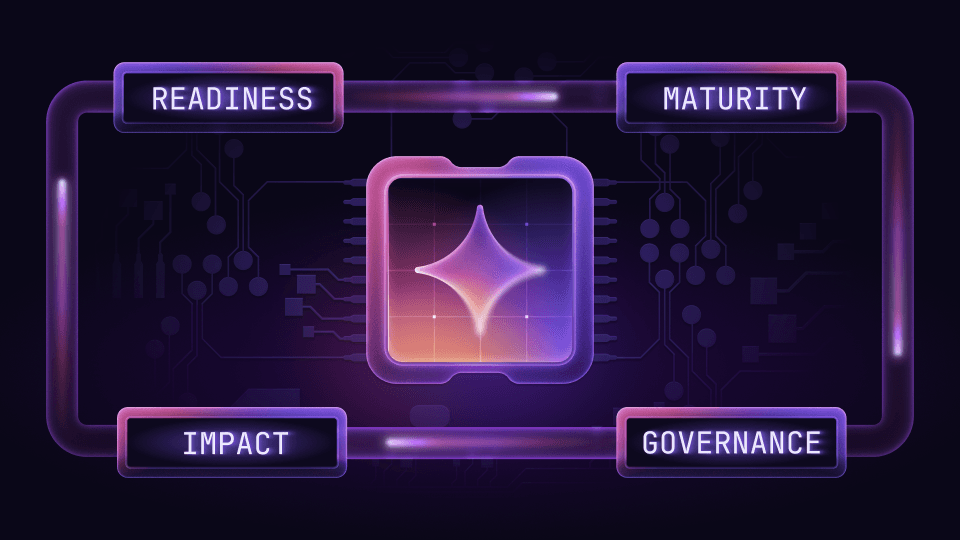
The organizations seeing real value from AI are building the infrastructure to make AI adoption measurable, governed, and continuously improving. They’ve known for a long time that their developers are using AI at large, and are now measuring AI adoption by asking themselves more difficult questions about readiness, maturity, governance, and impact.
Why measurement matters more than ever
We fund what we can prove delivers value. Platform teams need data to turn experiments into operational intelligence while developers need transparency to trust that AI helps rather than adds overhead. These are far from industry secrets. However, AI adoption becomes expensive guesswork if we don't measure it.
We found that while 58% of engineering leaders are "somewhat confident but mostly anecdotal" that AI is improving outcomes, only 33% report being "very confident with data to prove it." Meanwhile, 50% believe ROI is "likely positive but not yet quantified." This gap between confidence and measurement won't last. As budgets tighten and AI costs compound, we'll all need proof.
The problem is that our traditional metrics don't capture the full story. Deployment frequency and PR volume tell an incomplete story when code quality is declining and resolution times are growing. We need frameworks that measure not just velocity but also the readiness, maturity, governance, and true impact of AI adoption.
The four dimensions of effective AI adoption
Successful AI adoption requires measuring and managing four interconnected dimensions. We risk moving too slowly or break things at scale if we skip any one of them.
1. AI maturity tracks actual team adoption
We often assume our engineering foundations are ready for anything, but AI has a way of finding every crack in the system. The organizations in our research seeing better outcomes share a commitment to laying the foundation for AI through basics like testing coverage and clear service ownership. Engineering leaders consistently rank these unglamorous tasks as the most critical work for successful AI adoption.
AI tools are like enthusiastic junior developers who need context to do their best work. Service catalogs provide that context by helping AI understand existing patterns and respect service boundaries. If ownership is unclear or documentation is sparse, AI-generated code will cross boundaries it doesn't understand. This often breaks patterns that aren't documented anywhere.
Platforms like Cortex create the foundation AI tools need by automatically mapping your services. You give AI the context required to generate code that fits your architecture when you ensure every service has clear ownership.
Defining what "AI-ready" actually looks like for your team is helpful. Scorecards let you create checks that ensure services have proper documentation before AI tools can modify them. This prevents AI from amplifying the bad habits we all try to avoid.
2. AI maturity tracks actual team adoption
Real maturity is harder to spot than counting how many licenses you’ve provisioned. It measures how systematically teams use AI tools and redefines developer productivity in the AI era by looking at whether adoption spreads to become standard practice.
We struggle with this because adoption often happens in the shadows. Some teams might use GitHub Copilot heavily while others experiment with Cursor or rely on personal ChatGPT accounts. Identifying what works or standardizing on valuable approaches becomes difficult when we lack visibility into these patterns.
Tracking adoption indicators across your organization through maturity scorecards helps paint a clear picture. It's valuable to know which teams have AI tooling integrated into their workflows and which services are modified with AI assistance. Knowing where teams see productivity gains or experience increased change failures is critical.
Measuring maturity at the team level helps you find the patterns that actually matter. You can track organic growth and help teams learn from each other instead of forcing a top-down mandate.
3. AI governance guardrails prevent chaos
Most of us worry about security vulnerabilities, yet few organizations have formal AI usage policies. This gap between our anxiety and our governance is where risk compounds.
Governance should act as a guardrail rather than a gatekeeper. It keeps teams aligned with your standards so they can move fast without breaking things. Teams will make their own decisions about which tools access sensitive codebases if we don't provide these guardrails.
Effective governance requires setting clear expectations that scale with your team. This might include mandatory code review for AI-generated changes or security scanning for all modified services.
Surfacing these requirements directly in developers' workflows makes governance feel like helpful guidance. Developers should be able to see what is required and take action without having to dig through a wiki to find the policy.
4. AI impact measures if it is actually working
This is where the traditional metrics often lead us astray. We see deployment frequency go up and assume everything's fine. Our research reveals a more complicated picture where teams ship more code that introduces significantly more bugs.
Measuring AI impact means looking at the full story of velocity and quality. We want to know if teams are shipping faster while maintaining reliability, and if resolution times are improving or if we're just creating more work for ourselves.
Engineering intelligence platforms provide the complete picture by tracking velocity metrics alongside quality metrics. This lets you see which teams capture velocity gains without quality penalties. The visibility helps you identify successful patterns and intervene before small problems become big incidents.
Hard metrics alone aren't enough. We should combine performance data with direct feedback from our developers. This combination reveals the complete story by tracking how your team actually feels about the tools they use.
A phased approach to putting this framework into practice
We know effective AI adoption doesn't happen all at once. Organizations seeing success follow a deliberate progression. This pattern is consistent across companies of all sizes.
Phase 1: Establish your baseline
We can't improve what we don't measure. Understanding where you are today helps before encouraging broader AI adoption. What are your current deployment frequency and incident metrics? How complete is your service catalog? Without this baseline, we'll never know if AI is actually helping or just creating the illusion of progress.
Tools like Cortex Engineering Intelligence help you capture these metrics across your organization and establish scorecards that measure the readiness foundations. Track documentation quality, ownership clarity, and test coverage so you can see improvements over time rather than relying on gut feelings.
Phase 2: Start small with high-value use cases
The organizations that succeed with AI don't mandate adoption across all teams simultaneously. Instead, they identify teams or services where AI can deliver clear value with manageable risk. This usually means starting with well-documented, actively maintained services owned by teams with strong engineering practices. These early adopters become your proof points and help you identify patterns worth scaling to the rest of the organization.
For these pilot teams, maturity scorecards track adoption patterns and measure impact on velocity and quality. Document what governance practices prove most effective. Cortex Initiatives help ensure pilot teams follow baseline requirements around code review and documentation without feeling like they're constantly audited.
Phase 3: Scale with governance
Once successful patterns emerge, the temptation is to scale as fast as possible. The organizations that thrive resist this urge and instead scale with clear guardrails. Organization-wide initiatives codify requirements for AI adoption, covering mandatory review processes, security standards, and quality gates. Scorecards track compliance and identify teams that need support before they run into problems.
The key is making governance visible where developers already work. The Developer Homepage ensures every developer knows what's required of them and can take action without hunting for policies buried in Confluence. Governance stops feeling like overhead and starts feeling like support when it becomes embedded in workflows rather than enforced through spreadsheets.
Phase 4: Measure and iterate continuously
AI tools evolve rapidly. What works today might not work in six months, and new capabilities constantly emerge. Organizations that treat AI adoption as a "set it and forget it" initiative quickly fall behind. The successful ones build feedback loops that combine engineering metrics, developer surveys, and incident data to understand how AI adoption is actually affecting their organization.
Leadership needs visibility into this data. Cortex dashboards show how AI is impacting deployment frequency and change failure rates across different teams and services. They track how governance initiatives are progressing and where teams are struggling. This transparency turns AI adoption from a leap of faith into a managed, measurable program where decisions are based on evidence rather than enthusiasm.
The infrastructure that makes AI adoption sustainable
AI won't eliminate complexity by itself. It creates more chaos than it solves without the right infrastructure for measuring readiness, maturity, governance, and impact.
The teams that thrive with engineering excellence in the age of AI in 2026 will be those that built the foundations in 2025. They'll be the ones who can prove ROI with data and scale adoption safely with governance. They'll continuously improve based on feedback loops that connect engineering metrics to business outcomes.
Cortex provides the infrastructure to make this possible. Our catalogs create the context AI needs to operate safely. Our Scorecards and Initiatives ensure adoption happens with proper governance and measurable progress. Our Engineering Intelligence closes the loop by showing whether AI delivers real value or just generates more code that introduces more problems.
The question isn't whether to adopt AI given that nearly 90% of teams already have. The question is whether you have the infrastructure to make that adoption effective, governed, and measurable. That's what separates organizations capturing the 20% velocity gains from those experiencing 30% increases in change failures.
Ready to build the infrastructure for effective AI adoption? Book a demo to see how Cortex helps engineering teams measure readiness, track maturity, enforce governance, and prove impact.