
Ask a software engineer what they do and the answer, for years, has been some version of "I write code." That assumption is unwinding fast. AI agents can now write code, review pull requests, run tests, and ship to production, and they're taking on a fast-growing share of that work.
As agents absorb more of the execution, the human role shifts. Engineers spend less time writing individual changes and more time designing and running the system that produces them: setting the standards, building the guardrails, deciding what good output looks like. That is the shift an AI software factory describes: from working inside the system to designing the system itself.
This article defines the AI software factory, what’s being automated, the critical foundational layers, and how engineering leaders are measuring and managing a factory they no longer build by hand.
Defining the AI software factory
An AI software factory is an organizational system that turns customer needs into shipped, reliable software, with AI agents doing the building while engineers move up a level to design and operate the system itself.
An important distinction: NVIDIA and other infrastructure makers use the phrase "AI factory" to describe a data center built to manufacture intelligence at scale, physical infrastructure that turns compute and power into AI output. That's a hardware story. It is unrelated to the AI software factory.
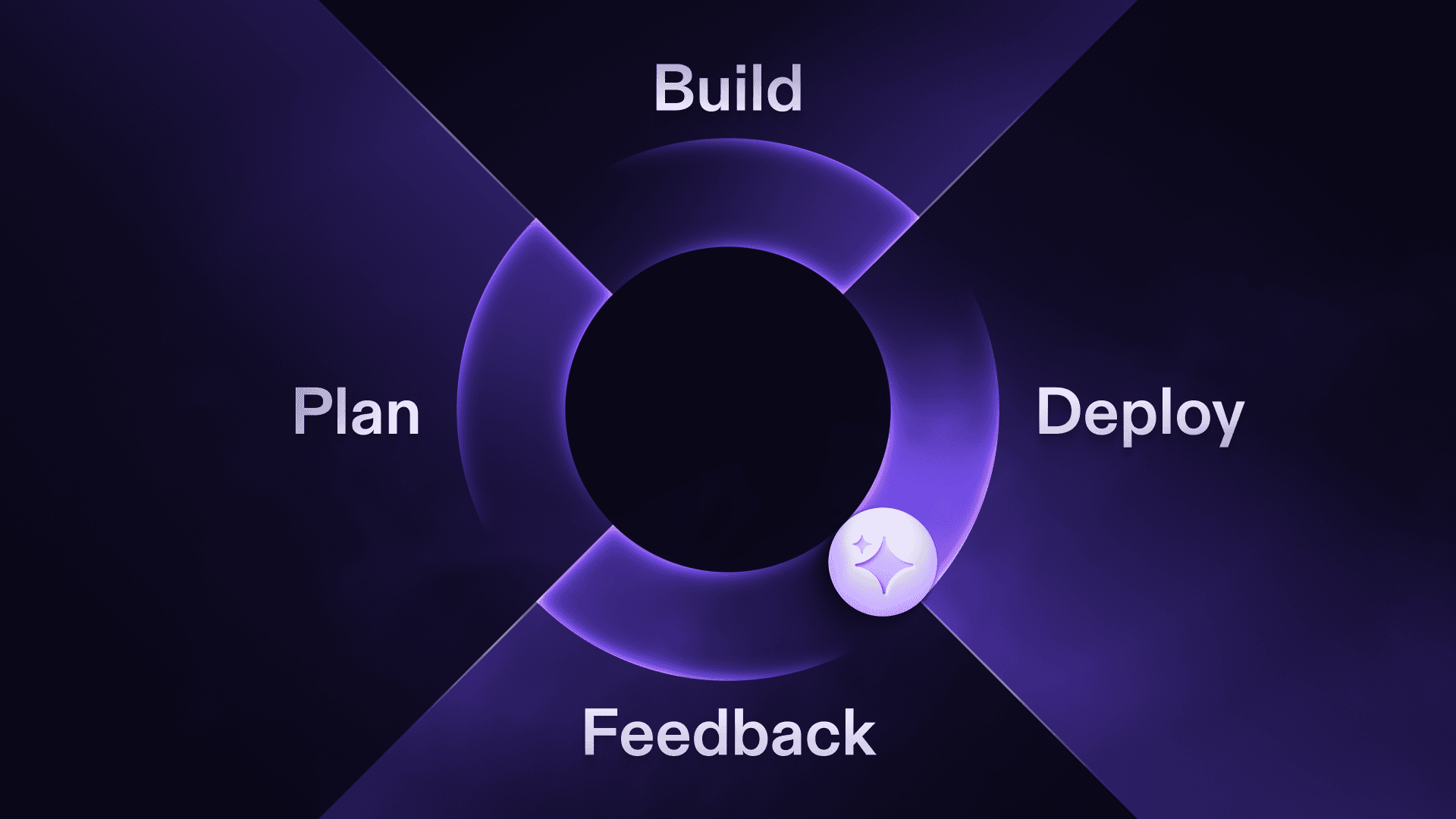
Every engineering organization already has a software factory. It’s called the software development lifecycle. Work flows through four broad phases: plan, build, production, and feedback that turns back into the next round of work. Strategic bets become product and technical specs, specs become tickets, tickets become pull requests that get reviewed and merged and deployed, and the incidents, monitoring, and customer feedback that follow inform the next set of priorities. That loop has always existed. What's changed is that AI agents can now do meaningful work at nearly every phase of that loop. The important question that follows is no longer how quickly an individual moves through their part of it, but how well the loop itself is designed and operated as a whole.
Some organizations are already running mature versions of their AI software factories, like Ramp, Stripe, Anthropic, and OpenAI. Many more are in the early stages of automation, refining the pieces as the practice of software engineering changes every day. Few are standing still.
How the AI software factory runs
An AI software factory runs as a loop with agents doing the work inside it. An agent picks up a ticket and opens a pull request, another reviews the diff, the change moves through the CI/CD pipeline and on toward deployment. These are early multi-agent systems: agents handing work to one another inside the factory rather than a single assistant waiting on a prompt. A good deal of the recurring work that used to sit on an engineer's plate now runs as automation the engineer oversees and spends time fine-tuning rather than performs. The engineer's role shifts away from authoring individual changes and toward orchestrating the systems that author them.
This is no longer a leading-edge phenomenon. In the Pragmatic Engineer's 2026 tooling survey, regular use of AI agents had become the norm rather than the exception, with the heaviest adoption among staff and senior engineers, the people who tend to shape how their teams build. Work that agents could not reliably handle a year earlier, spanning multiple files and several steps, has become ordinary.
Once a change can be produced in seconds, the weight of the work shifts to everything that comes after it: the reviewing, testing, deployment, and operation that still have to happen and did not get faster just because the code arrived sooner. That is where running an AI software factory gets difficult.
What the factory runs on
An AI software factory rests on a few distinct foundational layers, each of which an engineering organization has to build, pay for, or maintain.
Compute and models: The agents themselves and the AI infrastructure to run them, from the GPUs the models depend on to the data pipelines that feed them context. This is an often underestimated cost. Unlike the cloud bills leaders have learned to forecast, agent spend is volatile, rising with every workflow handed to automation and capable of climbing faster than the teams running it expect.
Context: An agent is only as good as what it can see, so an organization's code, its history, its standards, and the accumulated knowledge of how it builds all become inputs the factory depends on (see the growing discipline of Context Engineering). Raw data scattered across tools doesn't help; the organizations getting the most from agents tend to be the ones that have turned it into context that is legible and kept current, rather than left to tribal memory.
Agents and their harnesses: The coding tools plus the orchestration around them that lets a change be planned, written, tested, and revised in a loop rather than one suggestion at a time. The harness is often what separates an organization that gets real autonomous work from one that gets a faster autocomplete.
The pipeline the work travels through: The build, integration, and deployment systems, and the environments a change has to clear before it reaches a customer. Agents have not removed these stages. They have increased the volume flowing through them.
The controls: Code review, testing, security checks, observability, Operational Excellence reviews. This is the operational layer meant to keep the factory's output reliable and safe, and it is the layer most reshaped by the shift, because the human-managed versions of these controls were built for a slower rate of change.
The first several of these layers have robust support, an industry's worth of tooling is aimed at making them faster and more capable. The controls, however, are not keeping pace. A factory can have abundant compute, rich context, capable agents, and a fast pipeline, and still ship unreliable software faster than anyone can catch it. That gap, between a factory that can produce and an organization that can stand behind what it produces, is the harder half of the problem.
The challenges of running an AI software factory
There are many vendors with tools to help companies build their software factory, from better agents to better orchestration and infrastructure. There are fewer tools that support the running of the factory, which is where challenges often arise. Below is a non-exhaustive list of some challenges of running an AI software factory.
Velocity outruns the controls
The operational layer downstream of code, the review, testing, on-call, security, and cost controls, has strained at scale for as long as engineering organizations have existed. AI did not create that problem so much as raise the pressure on it. The time between an idea and a pull request has collapsed, which means more change, arriving faster, landing on controls that were designed for human volume. Our own research bears this out: in the Cortex 2026 Engineering Benchmark Report, as pull request throughput rose, incident volume rose alongside it. Organizations have started producing software faster than they can safely operate it.
Leadership loses sight of the whole
The build loop is steadily being closed, while the governance loop around it stays wide open. Whether the system as a whole produces reliable, secure software at a cost the business can sustain, and whether leadership can see that clearly enough to act on it, is mostly left to instinct. Observability and audit trails that were adequate for a slower cadence begin to lag, and the gap between what shipped and what anyone actually reviewed widens.
Human checkpoints stop scaling
As the build loop gets more autonomous, the controls that used to depend on people stop holding. Code review is the clearest case: when an agent writes a change and another reviews it, human review at the level of each pull request is no longer something a team can sustain, and deciding how much autonomy an agent has earned becomes a judgment call leaders have to make deliberately rather than by default. The reflex is to add more automated gates, which is necessary work. But every automated gate operates on a single change. It can confirm whether a given diff passed its tests. It cannot say whether the organization is healthy, whether reliability is trending the wrong way across a domain, or whether a migration that matters to the business is quietly stalling.
Standards and ownership erode
When agents generate services and changes at volume, the question of who owns what, and whether each piece meets the bar for production readiness and security, degrades faster than anyone can track by hand. Ownership goes stale, standards drift, and the system of record that was already hard to keep current falls further behind the rate of change.
Taken together, these point to a single question: where can a human still meaningfully govern the factory? It is no longer at the diff, where people lose the race on volume alone. The place a human can still steer is at the level of the system, looking across patterns and trends in the whole loop and deciding where to push harder and where to ease off.
How leaders measure and manage the factory
The difficulty leaders face is that the instruments most teams reach for are pointed at the wrong unit. DX Core 4 and SPACE are built to gauge how effective individuals and teams are. Neither was designed to reveal whether the organization, taken as a whole, can reliably convert what customers need into working software at a price the business can carry. That measurement gap isn't new, but AI has made it too large to overlook: a team can post faster numbers for every developer and still, collectively, get worse at shipping software it can stand behind.
DRIVE is the framework built for that missing layer. Where existing frameworks describe how a team's developers are performing, DRIVE describes whether the organization wrapped around them can hold its commitments. It assesses organizational effectiveness across five pillars, Delivery, Reliability, Initiatives, Vigilance, and Efficiency, and it's designed to sit on top of the signals teams already collect, including DORA's four key metrics.
Measurement alone changes nothing, so DRIVE ties those pillars to a recurring operational review. This is where managing the factory actually happens. The lineage runs back to manufacturing, where running the whole plant as one observable system, with the people on the floor empowered to halt production the moment something went wrong, acquired a name: Operational Excellence. The operational review is software's inheritance of that idea.
Some of the world's strongest engineering organizations, AWS, Stripe, and Google among them, have run some form of operational review for years, long before AI, despite having every automated gate available to them. A gate can only judge the change in front of it, it cannot say whether the organization producing those changes is in good shape. A review can. On a fixed cadence, the people responsible for the system look at it whole, review pillar performance, and move resources toward whatever is most at risk. It is the clearest place a human still steers a factory that increasingly runs itself.
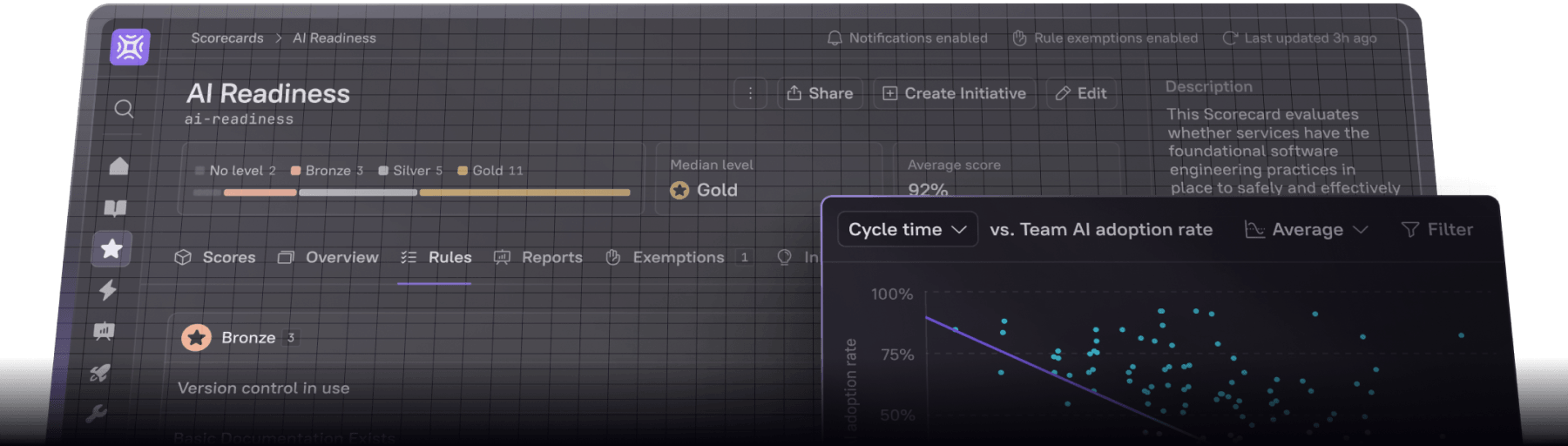
Running the review well depends on having a reliable picture of an organization's services, who owns them, and what standards they're held to. A system of record for that, where ownership and operational standards live and stay current, is what grounds the review in real data instead of stale spreadsheets. This is the work of Engineering Operations: building the systems that let the factory run fast without losing control. Cortex is building its own software factory in the open. The first devlog covers why the factory is an operating model, not a coding agent.
When output starts to outrun an organization's ability to manage it, the natural reaction is to pump the brakes. The trouble is that pumping the brakes without a reason tends to hide the bottlenecks that were already there rather than fix them, and it hands an advantage to teams that figured out how to run fast safely instead of treating speed as the enemy. The most successful leaders know which moments call for restraint and which call for pressure, and have built the operational discipline to tell the difference in real time.
Download the DRIVE framework to see the full five-pillar model and how to run an Operational Excellence review for your organization. Take the DRIVE assessment to see where your organization stands today.
Frequently asked questions
Is an AI software factory the same as the software development lifecycle (SDLC)?
An AI software factory is the SDLC with AI agents doing work across it. Every organization already has a software factory in the sense that work flows through four broad phases, plan, build, production, and feedback, with what happens in production becoming the next round of work. What changes in an AI software factory is that agents handle much of that work, which shifts the engineer's focus from running individual phases to designing and operating the loop as a whole.
How is an AI software factory different from coding agents?
Coding agents are components inside the factory, not the factory itself. An agent that writes a pull request or reviews a diff handles one stage of the lifecycle. The factory is the full loop those agents operate within, from intake through production, along with the controls that keep the output reliable and secure. A capable agent makes one stage faster; it does not tell you whether the organization can sustainably ship what it produces.
Does an AI software factory replace engineers?
No. The work moves up a level rather than away. Engineers spend less time writing each change and more time designing the systems that produce changes, setting the standards those systems follow, and governing the parts of the loop that still need human judgment. The clearest example is the operational review, where humans assess the health of the whole organization rather than any single change.
Does faster code generation lead to more incidents?
It can, and the early data points that way. The Cortex 2026 Engineering Benchmark Report found pull request throughput and incident volume rising in close step, which suggests organizations are producing software faster than they can safely operate it. The controls downstream of code, review, testing, deployment, and on-call, were built for human volume, so when the time between an idea and a pull request collapses, more change reaches them faster than they were designed to absorb. Faster generation doesn't cause incidents on its own; it exposes whether the operational layer can keep up.
How do you measure an AI software factory?
The key is to measure it as a system rather than as a collection of individual developers. The DRIVE framework does this across five pillars, Delivery, Reliability, Initiatives, Vigilance, and Efficiency, paired with a recurring Operational Excellence review that turns the measurements into decisions about where to allocate time, people, and money. The review is what keeps measurement connected to action instead of becoming a dashboard nobody acts on.