
Engineering teams are writing more code than ever. AI coding tools have made individual developers dramatically more productive, yet most organizations report moving only about 20% faster than before.
The real constraint has always been the operational fabric surrounding the act of writing code. The processes, standards, visibility, and coordination that determine whether hundreds of engineers and thousands of services ship reliable software at speed have always been where the real work happens.
That foundation now has a name, and it's Engineering Operations.
What is engineering operations?
Engineering Operations (EngOps) is the organizational discipline dedicated to improving how an engineering team works, not just what it builds. It's the mission control of the engineering org, focused exclusively on making the whole machine run better.
The mere existence of the term is long overdue. Every other major function in a modern company has an operational counterpart. Sales Ops analyzes pipeline data, spots bottlenecks, and enables reps to close faster. Marketing Ops owns the toolstack, the measurement layer, and the processes that make campaigns reproducible. Revenue Ops, Finance Ops, Product Ops all exist to make their parent function better at the actual job.
Engineering is the largest cost center and the primary engine of innovation in most technology companies, yet it historically lacked an equivalent. Decisions about standards, tooling, readiness, and continuous improvement get distributed across Platform Engineering, SRE, DevEx, DevOps, and Security Engineering, with each team largely operating in its own silo.
Engineering Operations brings all of those functions under a single operational mindset. The shared goal is making the engineering organization better at serving customers, working together rather than optimizing each discipline in isolation.
Why engineering operations matters now
Three forces are making EngOps a strategic priority in 2026, and they're each compounding the pressure on engineering organizations to build this muscle.
AI has inflated code volume without improving the processes around it. Coding agents can generate pull requests in minutes, but deploying that code safely, ensuring it meets organizational standards, understanding who owns it, and recovering when it fails all get harder when code volume multiplies. Organizations that lack operational maturity will struggle under their own output.
Complexity at scale is a human problem, not a software problem. Microservices taught us this once. The architectural pattern was sound, but the operational chaos that followed ("who owns this service?") was a coordination failure. The same dynamic plays out with any distributed scale, whether across teams, services, or AI-generated components.
The market has already rendered its verdict. Companies like Block, WHOOP, Microsoft, and 1Password have built formal Engineering Operations functions and are actively hiring to grow them. Meanwhile, teams at Etsy, Netflix, H&R Block, Skyscanner, and Xero are using operational platforms to drive continuous improvement, establish shared definitions of production readiness, and reduce friction so developers can focus on building. What was once a competitive differentiator available only to the most well-resourced teams is quickly becoming a standard expectation.
Core responsibilities of engineering operations
While the exact scope varies by organization, Engineering Operations consistently owns four areas of accountability.
Operational Excellence & continuous improvement. You can only improve what you measure – so you need to measure your operational maturity holistically to improve it. Engineering Operations develops the cadence and KPIs that are used to measure the maturity of the organization across reliability, security, and velocity; this spans productivity/efficiency like DORA metrics, to cloud costs, vulns, incidents, SLOs, org-wide initiatives, and more. This extends past just owning the data, but also driving forward the improvements & best practices that lead to real outcomes.
Reliability and Incident management. EngOps teams own the incident lifecycle end to end, making sure classification, escalation paths, postmortems, and follow-through are consistent across the organization. That means partnering closely with Platform and SRE teams on root-cause visibility and operational readiness, with a focus on building the mechanisms that prevent repeat incidents rather than just responding to them.
Developer Experience & Reducing Friction. Platforms and tools should get out of the way and boost productivity. From making new engineers productive quickly to providing golden paths that make doing things the right way the easy way, Engineering Operations is focused on reducing toil so that builders can focus on building.
Security, Governance, and compliance. Security and compliance are a core customer expectation and one that every engineering team is responsible for. Engineering Operations is about translating these requirements into clear, actionable practices that the broader organization can adopt to continue meeting the business’s security bar.
What engineering operations roles look like
Engineering Operations as a formal function is relatively new, and titles still vary across organizations. The roles are converging around a recognizable set of responsibilities, though, and the hiring market reflects it.
The most senior role, often Director or Head of Engineering Operations, typically reports directly to the SVP or VP of Engineering and serves as the operational backbone of the software organization. This leader owns the systems, processes, and visibility mechanisms that enable teams to deliver at scale.
Below that, specialized organizations build out the supporting functions. The Engineering Operations leader drives cross-functional initiatives across their child teams – Platform/DevEx, SRE, DevOps, and Security teams. Developer Experience and Platform Engineering focus on reducing friction and improving developer productivity in ways that actually show up in the data. Site Reliability Engineers own reliability standards, incident response, and production readiness. Security engineering sets guardrails and governance to ensure a high bar of excellence.
What ties all of these roles together is a shared orientation toward making the engineering organization better at its work, and building the systems that keep it improving over time.
How Cortex powers engineering operations
Cortex is an Engineering Operations Platform built for the entire engineering organization, whether you're a CTO providing vision and direction, an SRE managing reliability, a Platform Engineer building internal tooling, or a developer trying to figure out who owns a service.
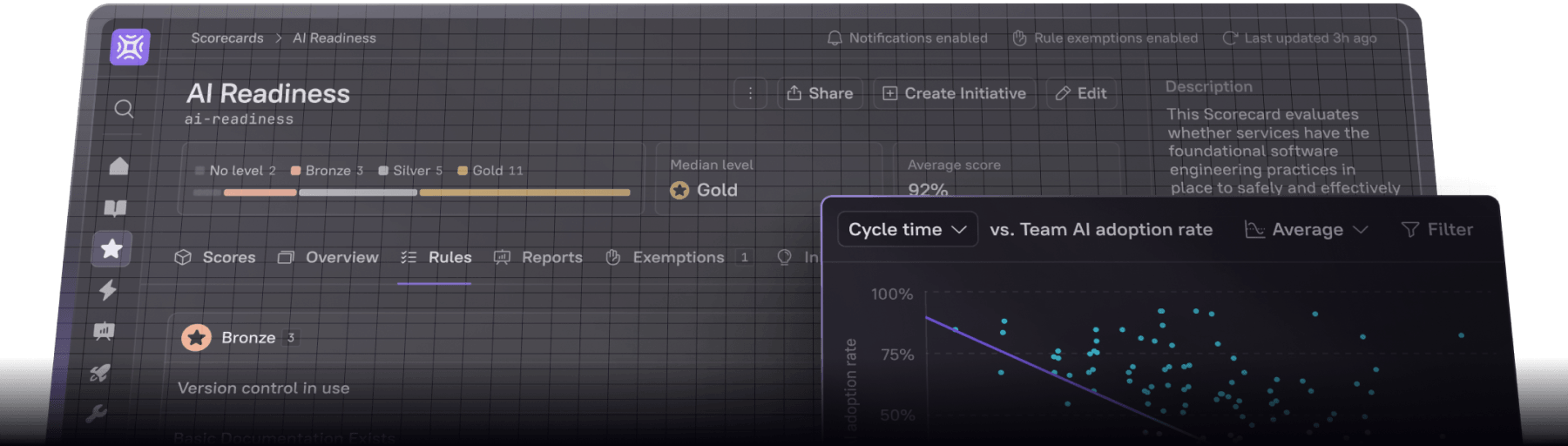
Cortex gives EngOps teams the data, workflows, and automation they need to actually run this function. The Service Catalog keeps a live inventory of every service, its owner, its health, and its compliance with organizational standards. Scorecards let teams define what "good" looks like across production readiness, security, reliability, and developer experience, and track progress against it. Initiatives give leaders a clear view into org-wide improvement programs while giving teams the prioritized next steps to move them forward.
Teams using Cortex supplement their best-in-class tools with a repeatable operating system for continuous improvement, one that scales with the organization rather than falling behind it.
Engineering operations is how great teams stay great
Every engineering organization will end up with some version of this function. The real question is whether you build it intentionally, with the right platform and process behind it, or whether you keep managing a growing system on spreadsheets and tribal knowledge. AI isn't going to slow the rate at which software complexity compounds, and the teams that invest in Engineering Operations now will be better positioned to keep improving as that complexity grows.
Ready to see how Cortex can help your team build its Engineering Operations practice? Schedule a demo.