
Context engineering is the practice of managing the information an AI model sees (documents, tool outputs, memory, and structured metadata about the systems it reasons over) so it can make accurate decisions inside a real engineering organization.
Most engineering teams have access to the same AI coding agents, built on the same frontier large language models (LLMs): Claude, GPT, Gemini, the major variants everyone is shipping. The model is no longer the differentiator. What separates the teams getting real leverage from AI from those falling behind is how they manage the information those agents operate on: how they curate it, keep it current, and get it out of the way when it isn’t needed.
This work has existed for a while. The industry now calls it context engineering: the discipline of selecting, maintaining, and shaping the information an AI model sees so it can actually do its job inside a real engineering organization.
Prompt engineering got us through the first two years of GenAI. It was useful when most interactions were one-off. An engineer asked a chatbot a question, tuned the words, and got a reasonable answer. Agentic systems changed the process. An agent running in your CI pipeline, opening pull requests, or responding to an incident is pulling from a dozen upstream sources across every run. The quality of its output depends on whether those sources are accurate, current, and relevant to the task in front of it.
Context engineering is where the work is.
What is context engineering?
Context engineering is the practice of managing the information an LLM consumes. That includes the documents a Retrieval-Augmented Generation (RAG) system pulls in, the tool outputs an agent receives mid-run, the short-term memory it carries across a session and the long-term memory is accumulates across them, and the structured metadata about the systems it's reasoning over.
The surface area is enormous. Context includes the obvious things, like the documentation you point an agent at and the tools it has access to. But it also includes ownership data (who runs this service?), system state (is it healthy right now?), recent changes (what shipped in the last 24 hours?), organizational standards (what does "production-ready" mean here?), and the boundary conditions of the task itself (what is the agent allowed to touch?).
Prompt engineering sits inside context engineering. A well-worded prompt still matters, but it's one input among many. The other inputs are the schemas, READMEs, service ownership records, deployment states, incident histories, and standards the model pulls from when it reasons. If any of those are wrong or stale, a perfect prompt can't save the output.
Engineering teams are wiring AI into pull request review, incident response, service creation, onboarding, and production readiness checks. Each of these use cases depends on the model having accurate information about the organization. A confident hallucination is worse than no answer at all.
This is why context engineering is starting to sit next to CI hardening and incident response on the list of things engineering excellence actually depends on. It's an operational discipline with the same shape as the others your team already practices: decide what good looks like, build the systems that maintain it, and make those systems queryable by the things that depend on them.
The business value of context in engineering programs
The honest version of the AI productivity story is that most organizations are getting speed without quality. Pull requests are landing faster. Code is shipping faster. Incidents are not going down. Security findings are not going down. Onboarding time is not getting better. The agents are working, but the system around them is the same one that produced last quarter's problems.
This is what context engineering exists to fix. Speed comes from the model. Quality comes from the context.
Prompt engineering helped individual engineers get more out of a single agent session. It does not scale to an organization. Every engineer hand-tuning their own system prompts and agent rules produces a different result for the same task, which means the standards your platform team enforces in CI are not the same standards your AI is enforcing when it writes the code. You end up with two sources of truth, and one of them is whatever the loudest engineer decided to put in their prompt last week. Organizations that want reliable AI output across hundreds of engineers and thousands of services need a system-level approach.
Picture an engineer sitting at a workstation with fifty browser tabs open: the latest Jira ticket, three Slack threads, last quarter's RFC, four versions of the service README, a Grafana dashboard, the PagerDuty schedule, and half-written Notion pages. They can technically see everything. They also struggle to find the one piece of information that matters for the decision in front of them. AI agents behave the same way. They have to pick the right needle from a haystack that grows every day, and the more they have to pick from, the more often they pick wrong.
The goal is what some teams have started calling Minimal Relevant Context: give the agent the smallest possible set of accurate, current, relevant information that lets it act decisively. Anything more is noise, and anything less is guesswork. Getting this right is how organizations turn AI from an interesting experiment into a productivity layer that can scale.
The necessity of context engineering
Engineering organizations did not design their information architecture for AI. They designed it for humans, who are good at picking up context cues, asking around, and remembering that the actual ownership for the payments service is Sarah’s team even though the wiki still lists someone who left two years ago.
Three structural realities of how engineering organizations actually run make context engineering unavoidable.
Source material decay. AI is only as good as the documentation, runbooks, and service descriptions it draws from. If your service README hasn't been updated in 18 months, the model's advice is 18 months behind. The half-life of internal documentation is measured in weeks for fast-moving services and months for stable ones. Nobody updates docs because their incentives say to ship the next thing. The result is an entire substrate of "truth" that the agent treats as authoritative and is, in fact, wrong.
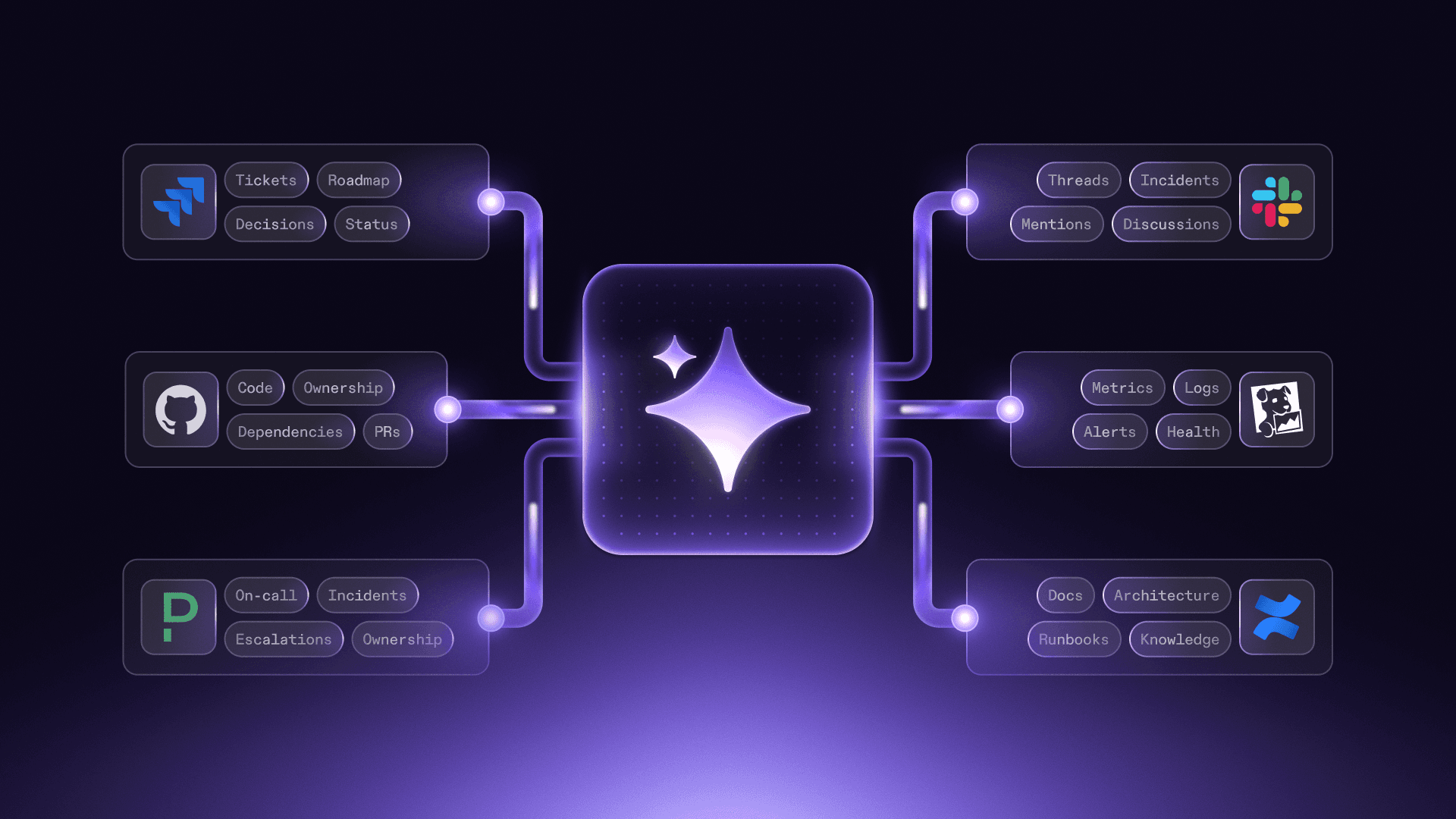
Information lives in silos. Ownership sits in PagerDuty, dependencies sit in GitHub and Terraform state, health metrics sit in Datadog, and standards live in a Confluence page someone wrote during the last re-org. Without a unified view, an agent can't reason across these systems. It sees fragments and guesses at the whole.
Noise drowns signal. The instinct to fix the silo problem is to give agents access to everything. The result is a phenomenon now called context rot, the slow degradation of agent quality as the volume of irrelevant context grows. When teams indiscriminately pump every Slack thread, Jira comment, and commit message into the agent's context window, the result is a flood of low-signal information that drowns out the specific context the model actually needed. More data, paradoxically, makes the agent less useful.
Key challenges with context engineering
Most failures in AI-driven engineering workflows are context failures, meaning inaccurate, incomplete, or stale inputs the model couldn't overcome. The constraints below are practical limits of how LLMs process information, and each one shapes what good context engineering has to account for.
Context rot and the needle in a haystack
LLMs don't read their context window evenly. Research on attention patterns shows a U-shaped curve, often called "Lost in the Middle," where models reliably recall information at the beginning and end of their input but struggle to retrieve details buried in the middle. Dump a 100,000-token prompt into a frontier model, and the critical line of code sitting at token 47,000 might as well not be there.
Simply adding more data to the context window doesn't make an agent smarter. Past a certain point, it makes the agent worse at finding the specific instruction or data point that matters for the current task. Good context engineering thins the input so the signal stays reachable.
Context poisoning and cascading errors
When an agent hallucinates a fact or misinterprets a tool output, that error gets written back into the agent's working context and becomes part of what the agent treats as true. On the next turn, the agent reasons forward from a wrong assumption, and the error compounds.
This is especially dangerous in long-running, iterative agent sessions. A bad tool call in step 3 can quietly poison the agent's reasoning all the way through step 15, at which point the only fix is to reset the session and lose the work done in between. Context engineering has to include strategies for catching errors before they propagate.
The token economy and latency trade-off
Every token an agent processes costs money, and every token adds latency. Engineering teams trying to build responsive AI workflows have to balance the desire for a well-informed agent against the reality of API bills and user expectations for sub-second responses.
Bloated context leads to slow, expensive agents. Teams that skip this discipline end up with AI features that cost more than they save and irritate the engineers who are supposed to benefit from them. Engineering Minimal Relevant Context becomes a real optimization problem, solved through sophisticated retrieval, caching, and compaction, such as compressing older turns into a running summary, rather than by stuffing more tokens into the prompt.
Context confusion (the "too many tools" problem)
Giving an agent access to 50 tools does not make it 50 times more capable. In practice, it creates analysis paralysis. Each tool is exposed to the model as a function it can call, using the function-calling interface OpenAI popularized. LangChain's research on agent performance shows that accuracy degrades as the number of functions available to an agent increases. The agent spends more reasoning budget selecting the right one and makes more redundant or incorrect calls.
The workaround most teams converge on is a multi-agent architecture, where a coordinating agent routes work to specialized sub-agents that each have a narrow tool set. That solves the confusion problem but adds orchestration complexity. Either way, context engineering has to decide what tools and data sources an agent sees at any given moment.
Semantic drift and knowledge staleness
Internal engineering context changes faster than models get retrained. A service's ownership can change three times in a quarter. A dependency gets deprecated. A standard gets revised. If the RAG pipeline pulls a README that was accurate six months ago but has since been overtaken by events, the agent's advice is going to be dangerously wrong.
Keeping context live is a data engineering problem, not a prompting problem. It requires pipelines that continuously sync from source-of-truth systems, versioning that lets teams audit what the agent saw and when, and mechanisms for flagging stale sources before an agent acts on them.
The solution is context engineering
Most of what people call AI failures are context failures. The model didn't have the right information, or it had too much of the wrong information. This ongoing context management is what keeps AI reliable as teams, services, and architectures change underneath it.
An agent responding to a production incident needs to know whether the service is currently deploying or whether its health checks are failing right now. Stale data is worse than no data, because stale data masquerades as truth. Context engineering is a long-term, iterative discipline, closer to how good teams manage observability data or security posture than a one-time optimization you finish and walk away from.
The teams that take this seriously stop asking "is our AI working?" and start asking "is our context layer healthy?"
How Cortex helps manage context for engineering teams
Cortex was built for the question "is our context layer healthy?" before the AI era made it the most important question an engineering organization can ask.
Cortex's thesis has always been that engineering excellence depends on a single source of truth for the state of your software: services, owners, dependencies, standards, health, history. The catalog, the scorecards, the workflows, all of it exists to keep that source of truth current and queryable. That work was valuable when the consumers were human engineers trying to onboard, ship, and pass audits. It is essential now that the consumers are also agents trying to do the same things in milliseconds.
The Software Catalog keeps the context current. Every service, API, resource, and team is connected to your identity providers and DevOps tools. Ownership reflects the org chart as it is today. Dependencies reflect the codebase as it is today. Health reflects production as it is right now. There is no spreadsheet to update. There is no wiki to maintain. The catalog is the source the rest of the platform reads from, and it is the source agents should read from too.
Cortex MCP gives AI agents a direct, governed connection to that context. Instead of pointing an agent at raw GitHub, PagerDuty, and Datadog APIs and hoping it figures out the right joins, agents query the Context Graph, which already resolves ownership, dependency, and health relationships. The MCP is Minimal Relevant Context by design, filtered and scoped to what the agent is actually trying to do.
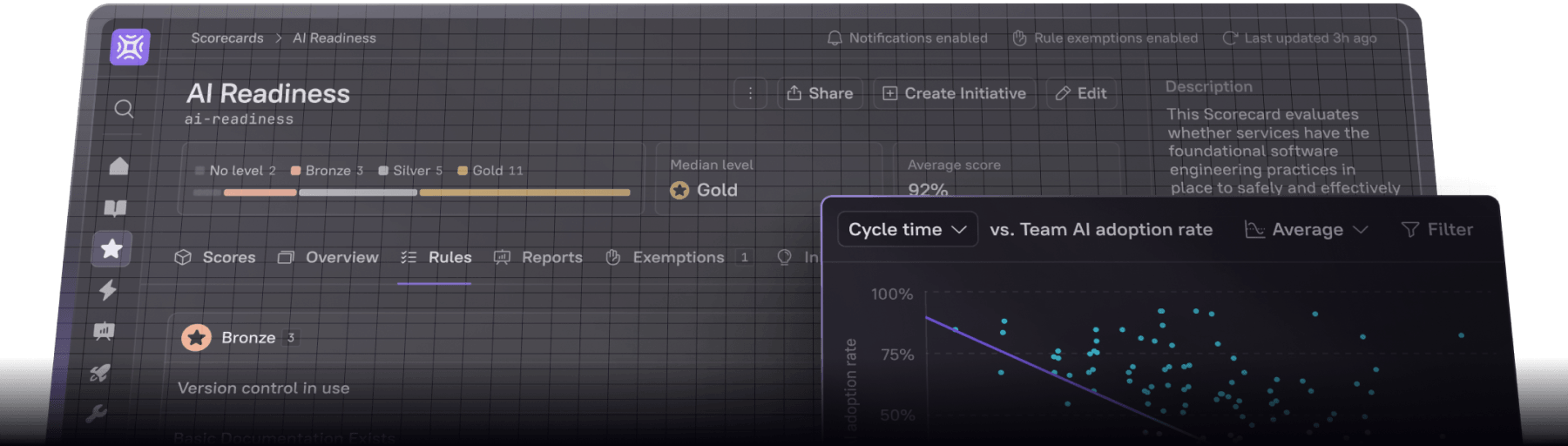
Engineering Intelligence and Scorecards make the context layer measurable. Scorecards flag stale READMEs, missing ownership, and drift from standards before an agent ever reads them. Maturity, velocity, incidents, AI adoption: if your context layer is decaying, you can see it. If your AI rollout is producing PRs that fail production readiness checks, you can see that too.
This is what we mean by Engineering Operations, the category Cortex named because the problems engineering organizations face at scale are no longer about writing code. They are about coordinating the system that produces and operates the code. AI agents inherit that system. They succeed or fail based on whether the system gives them ground truth.
Schedule a demo with Cortex to learn more.
FAQs
What's the difference between prompt engineering and context engineering?
Prompt engineering focuses on the exact words and structure of a single instruction to a model. Context engineering is the broader practice of managing everything the model sees around that instruction, including retrieved documents, tool outputs, memory, and the structured metadata about the system it's reasoning over. A well-written prompt still matters, but it sits inside context engineering as one input among many.
A useful way to think about it: prompt engineering is what a developer does in a chat window, and context engineering is what a platform team does so every chat, every agent, and every AI-powered workflow in the org gets reliable inputs without each developer having to re-solve the problem.
What business outcomes does context engineering improve?
The most direct outcome is closing the gap between AI speed and AI quality. Incident response gets faster when the on-call agent has live ownership and dependency data. Code review catches more issues when the agent reasons against current service standards rather than six-month-old documentation. Onboarding gets shorter when new engineers can ask an AI questions about the system and get accurate answers.
At the financial layer, it also reduces token spend, since scoped context is dramatically cheaper than the throw-everything-at-the-model approach. The throughline is that quality compounds: an AI rollout that produces trustworthy output gets adopted; one that produces plausible-but-wrong output stays a science experiment.
Is context engineering just another word for RAG?
No. RAG is one technique within context engineering. It describes the pattern of retrieving documents from a vector store and stuffing them into a model's context window. Context engineering covers RAG but also includes tool output management, long-term memory strategies, sub-agent orchestration, live data integrations, and the governance work that keeps source systems accurate.
RAG answers the question "how do we retrieve documents?" Context engineering answers the larger question of what to retrieve, when, from where, how to keep it current, and what to discard.
How can teams reduce the risk of context poisoning in AI systems?
Context poisoning happens when an agent treats a hallucinated fact or misread tool output as ground truth and reasons forward from it. Defenses include:
Structure agent sessions so tool outputs are validated before they get written back into the agent's working memory. A bad output that never enters the context can't poison downstream reasoning.
Keep session lengths manageable and design for graceful resets so a poisoned session can be discarded without losing other work.
Log what the agent saw on each turn so teams can audit where reasoning went wrong and trace errors back to their source.
Guardrails libraries and structured output validation, such as forcing responses into a validated JSON schema, also reduce the odds of a hallucinated fact slipping into the context window in the first place.
How do I measure if my context engineering is actually working?
Look at the gap between what AI ships and what passes review. If senior engineers are catching frequent factual errors, ownership mistakes, or violations of your standards in AI output, the context layer is the likely cause. Other signals include:
How often agents cite deprecated services
How often they route incidents to the wrong team
How often they recommend patterns your platform team retired six months ago
How many tool calls the agent needs per task and how many are redundant
How much you're spending in tokens versus saving in engineer time, measured as latency and cost per successful task.
The mature version of this measurement is a dashboard that tracks AI output against the same maturity and readiness scorecards your human engineers are evaluated against. If your AI cannot pass the same bar your team sets for itself, the context layer is not where it needs to be.