
When your engineering standards live in markdown files that nobody's opened in five years, you've actually got nothing but ghosts posing as standards. Alex Williams, Principal Software Engineer at Skyscanner, says this was the reality across the organization after years of trying to scale production standards across hundreds of teams. Docs had drifted, rules had multiplied, and what started as a push for consistency had turned into collective confusion.
In his talk at IDPCON 2025, Alex shared how his team hit the reset button by replacing a scattered collection of checklists and manual dashboards with a single, measurable system powered by Cortex Scorecards. By moving away from performative compliance and toward incremental gains, Skyscanner's managed to turn the boring stuff into a driver for engineering excellence.
The problem with performative compliance
Over time, Skyscanner’s rules for reliability had spread across different teams and tools, with each one following a slightly different pattern. This inconsistency led to a culture where compliance often felt more like busywork than actual engineering.
"One of the rules said you must deploy every three weeks. So people added a space to their README file every three weeks just to pass the check. That is not useful." Alex Williams — Principal Software Engineer, Skyscanner
Skyscanner realized that engineers needed better systems that kept them from confusing each other with forgotten markdown files and enabled them to bring their standards to life through active measurement. They needed a way to see what was actually happening in their repos, not just what people thought was happening.
Building a common language for maturity
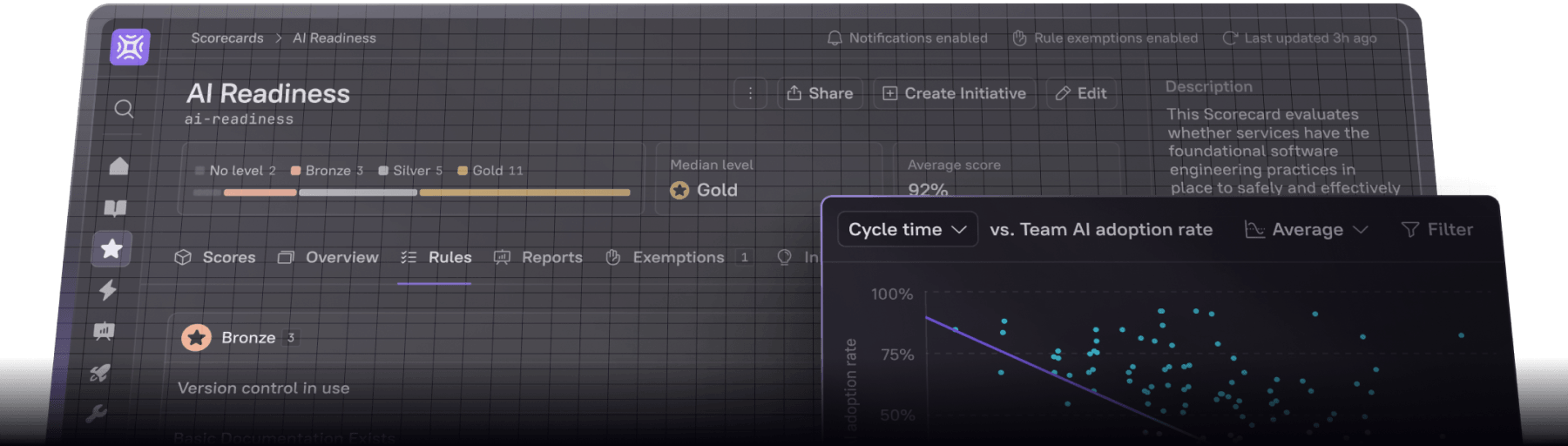
The team's first step was to consolidate their 200 forgotten markdown files into 15 clear categories. Each category now maps directly to a Cortex Scorecard, creating a common language that applies to every microservice, library, and data set in the organization. These scorecards provide developers with a real-time view of platform maturity against non-negotiable requirements.
To make this work, Skyscanner introduced a consistent leveling system across all 15 scorecards. It starts with a "sacred" baseline level for non-negotiables, like using specific programming languages or standard CI tools. From there, teams strive for the "mature" level, which represents where all graduated rules should eventually end up.
"Mature is where we want to be. It's the Goldilocks of the levels. If you have every one of your components across all 15 scorecards in this mature level, you've completed it. Go to the pub." Alex Williams — Principal Software Engineer, Skyscanner
This structure helps engineering managers know exactly what actions their teams need to take. Instead of navigating a maze of different rankings across various departments, every team at Skyscanner now uses the same maturity language. This clarity ensures that when a team sees an action item, they know exactly how it contributes to their overall progress.
Turning rules into outcomes through enablement
One of the most impactful shifts in Skyscanner's journey was moving from top-down mandates to an enablement-first culture. Alex's team realized that you can't just make a rule and expect 150 squads to drop everything and follow it. Instead, they empowered enablement teams to do the heavy lifting for the rest of the organization.
Skyscanner reaped the benefits of this shift when the CI team managed to move nearly 27,000 repos from one source control management system to another in just two months. The team focused on automating the change directly instead of relying on policy documents. They sent developers a calendar invite that simply said "run git remote update" and handled the rest of the heavy lifting behind the scenes.
The results of this measured approach are already showing up in new areas like AI governance. Alex says that one data engineer recently built 10 new AI maturity standards from scratch and plugged them into Cortex. Within 24 hours, the team saw 90% compliance across the board because they were measuring standards that the team was already following. By turning "oxygen" standards into visible goals, Skyscanner's proved that the right framework can turn scattered guesses into measurable progress.
Ready to dive deeper? Watch the full session from Alex Williams and other engineering leaders on demand. Access all IDPCON 2025 recordings here.