
Internal developer portals have become standard infrastructure for engineering organizations that begin to scale. Gartner's 2025 Market Guide for Internal Developer Portals projects that 85% of organizations with platform engineering teams will provide an internal developer portal by 2028, up from 60% in 2025. The appeal is practical: a portal gives engineers a single place to find services, look up ownership, trigger common workflows, and check whether what they're shipping meets organizational standards.
Port is one of the more prominent managed options in this space. Its core design decision is flexibility: a no-code data model called Blueprints lets platform teams define their own entities, relationships, and properties without writing plugins or maintaining an open-source framework. For teams that want a portal they can shape to their own standards without self-hosting, that flexibility is the primary draw. Port publishes transparent pricing with a free tier and counts LG and British Telecom among its customers.
Because Port is deliberately unopinionated, standards enforcement and golden paths are things your platform team designs and maintains on its own. The alternative products discussed in this article offer different takes on portals. They split on how much of the operating work the product owns and how much your team builds, which matters as engineering scales. At one end are blank-canvas portals you assemble and maintain yourself. At the other are platforms that treat the catalog as a starting point and take on what a portal alone never did, enforcing standards, tracking operational maturity, and governing how software ships and runs.
Port alternatives at a glance
How Port falls short as an IDP
Port works well for teams that want to build a portal on their own terms, but that same flexibility creates friction as organizations scale.
No built-in engineering semantics: Port is a bring-your-own-data-model system. Blueprints let you represent services, teams, and infrastructure however you want, but nothing arrives with meaning attached. A pull request, an incident, or a deploy is a custom blueprint until someone on your team models it, so there is nothing to roll up by team or service until you have built that model and kept it current. The flexibility is real, and so is the setup and maintenance cost before you get your first useful report.
Complexity and state management: Port's Blueprints model works well for representing static relationships between services, teams, and infrastructure. It is less well suited to use cases where the portal needs to reflect the operational state of systems or processes. A G2 reviewer (Lead Platform Engineer) noted that Port is "not always well suited to more complex use-cases where it needs to reflect the 'state' of systems or operations." For organizations that need their catalog to answer questions about what is happening right now, not just what exists, this is a limitation.
Data ingestion strains at scale: Port leans on retry backoffs to handle third-party rate limits rather than adaptive throttling. For a few dozen repositories that is fine. Across thousands, basic backoffs mean ingestion stalls and Scorecard calculations run against stale or incomplete data, which undercuts the entire premise of a catalog leaders can trust. Self-hosted integrations built on Port's Ocean framework compound this, since you deploy, host, and scale those connectors in your own infrastructure.
Standards enforcement is yours to build and maintain: Port ships scorecards and automation but few opinions about how to use them. Golden paths, governance policies, and maturity frameworks are things your platform team designs, builds, and owns. The scorecarding covers the fundamentals but thins out at enterprise depth. For organizations running standards across hundreds of teams with complex ownership models, that gap means substantial and ongoing customization on top of the portal itself.
Cost at scale: Multiple practitioners have flagged that costs grow quickly with team size. One Reddit user called Port "insanely expensive" at scale.
Alternative solutions to Port for developer portals and service catalogs
Cortex
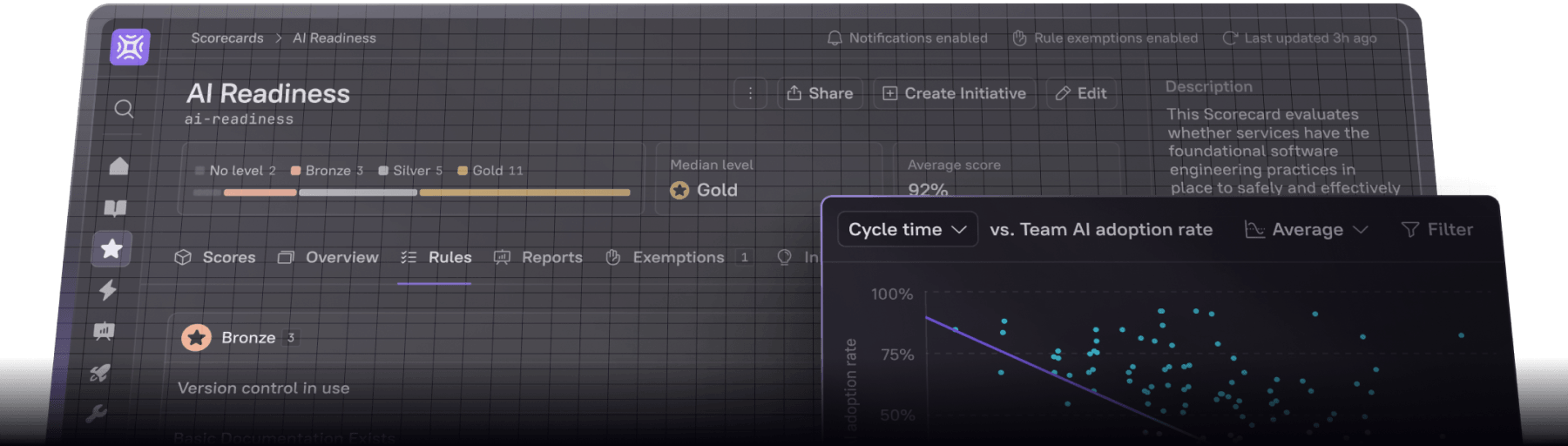
Cortex (G2 reviews) is an Engineering Operations Platform that acts as mission control for your AI software factory. It's a managed solution that includes a service catalog, but extends into standards enforcement through scorecards, operational maturity tracking, engineering intelligence reporting, operational excellence programs, and AI governance. Read a more in-depth comparison of Cortex vs Port here.
Pros
Faster time to value, starting with ownership. Cortex treats clear ownership and accountability as the foundation of a working platform, and builds from there. That structure means teams see value in days rather than weeks of configuration. Port's Blueprints model lets you bring your own data model, with or without ownership as a first-class concept, which means your platform team decides how (and whether) to enforce it.
Opinionated defaults, flexible when needed. Cortex ships with sane defaults for scorecards, workflows, and governance that work out of the box, but you can change them as your organization's needs shift. Port ships fewer opinions by design, which gives more freedom but also more setup work before the platform delivers value.
Enterprise-grade scorecarding and governance. Cortex's scorecard rules run against live integration data across your full stack, and hold up across hundreds of teams with org-wide rollups that give leaders a clear view of where the organization stands. Port covers scorecard fundamentals, but the governance layer stays lighter at the scale and complexity that large enterprises require.
Cons
Less customizable at the framework level than Port. Organizations that need a highly bespoke, from-scratch portal experience will find Port's Blueprints model gives them more room to build exactly what they want.
Designed for engineering orgs at scale. Smaller teams may not need the full breadth of scorecards, workflows, and reporting that Cortex offers.
Top features of Cortex
Context Graph & Service Catalog: Automatically maps services, ownership, and dependencies into a catalog that stays current, with AI that predicts ownership to fill gaps where it's unclear.
Scorecards with depth: Rules evaluate live integration data via CQL across your whole stack, so checks reflect reality rather than self-reported status. They hold up on complex ownership models and large datasets.
50+ out-of-the-box integrations across CI/CD, observability, identity, and more, all vendor-supported.
Workflows: Templated golden paths that help teams adopt org-wide standards, such as coordinating a runtime upgrade across all services.
Engineering intelligence and executive reporting: DORA metrics, cycle time, and AI adoption rolled into Bird's Eye dashboards that help leaders measure progress and identify blockers.
AI capabilities: The AI Impact Dashboard ties Copilot and Cursor usage to cycle time, MTTR, and change failure rate. AI readiness and governance scorecards track adoption posture. The OpEx Review Agent and AI chat (via MCP in Slack and IDEs) put operational context where engineers already work.
Backstage
If your platform team wants to own every layer of the portal, Backstage is the default starting point. Spotify open-sourced the framework, and it's now a CNCF Incubating project ranked 6th by velocity among 230+ CNCF projects. It gives you a software catalog, scaffolding templates, and a plugin architecture that lets a team build nearly anything. That control requires significant investment: you host it, maintain it, write or integrate plugins for search, RBAC, and anything beyond the base catalog, and keep up with a release cadence that can break plugin compatibility.
Pros
Full control over the portal experience; no feature ceiling.
Large plugin ecosystem and active open-source community.
No license cost.
Cons
An estimate from internaldeveloperplatform.org puts the cost of ownership at roughly $150,000 per 20 developers.
Roadie's community survey found that teams happy with self-hosted Backstage dedicated at least three engineers to it, some up to twelve.
Fixed data model with manual YAML ingestion. No out-of-the-box RBAC or production-grade search.
Gartner's 2025 Market Guide warns that organizations often mistake Backstage for a ready-to-use portal, underestimating the build effort.
Best for: Large teams with dedicated platform engineers who want full control and will build and maintain their portal in-house. Read a more in-depth Backstage comparison here.
OpsLevel
OpsLevel (G2 reviews) provides a managed SaaS service catalog with maturity scorecards that emphasizes automated catalog maintenance.
Pros
Fast deployment time: 30 to 45 day deployments are typical.
Users praise extensibility, API quality, and service-ownership tracking.
More opinionated than Port, which reduces the platform team's design burden.
Cons
Reviewers note a learning curve and "a lot of configuration" with "room for error."
Governance depth is mid-range; organizations needing enterprise-scale rollups or AI maturity tracking will outgrow it.
Best for: Mid-sized teams that want a managed service catalog and maturity scorecards without heavy setup. Read a more in-depth OpsLevel comparison here.
DX Fabric
DX (G2 reviews) measures developer experience and productivity using the DXI and DX Core frameworks, advised by the researchers behind DORA, SPACE, and DevEx. It was acquired by Atlassian in November 2025. In 2026, DX added Fabric, a context layer with a systems catalog, scorecards, and agent-ops tooling that plugs into Backstage as an entity provider.
Pros
Strong developer-experience measurement grounded in published academic frameworks.
Fabric adds catalog and scorecard capabilities on top of the measurement layer.
Integrates with Backstage as an entity provider rather than requiring a rip-and-replace.
Cons
The Atlassian acquisition introduces roadmap uncertainty for organizations not standardized on Atlassian tooling.
Newer catalog capabilities are less mature than purpose-built alternatives.
Scorecards lack depth for enterprise use cases.
Best for: Teams that lead with developer-experience and productivity measurement and want a catalog tied to those insights. Factor in Atlassian ownership when evaluating long-term fit.
Roadie
Teams that want Backstage's plugin ecosystem without the hosting burden have one dedicated option. Roadie (Gartner Peer Insights reviews) has run managed Backstage since 2020, adding RBAC, scorecards, Tech Insights, SOC 2 Type 2 compliance, and custom-plugin publishing on top of the core.
Pros
Eliminates Backstage's operational overhead: hosting, upgrades, and plugin maintenance are handled for you.
Gartner Peer Insights reviewers praise low maintenance overhead, responsive support, and faster time-to-value than self-hosting.
Tech Insights is highlighted as a differentiator for tracking technical standards across services.
Cons
Tech Insights is a paid add-on, and seat minimums and tier gates can frustrate smaller buyers.
You inherit Backstage's fixed data model and its limitations. Roadie handles the hosting and operations; the underlying architecture stays the same.
Less flexibility than self-hosted Backstage for organizations that need deep customization of the portal itself.
Best for: Teams that want Backstage's plugin ecosystem delivered as a hosted, managed service without the operational tax.
Humanitec
Humanitec (Gartner Peer Insights reviews) handles the environment and infrastructure provisioning that supports a developer portal. Founded in 2017, it provides a graph-based Platform Orchestrator that integrates with portals like Port, Backstage, and Cortex as the primary provisioning engine. The Orchestrator v2, launched September 2025, was redesigned to work with any compute and any resource across cloud and on-premises environments, including anything manageable through the Terraform and OpenTofu ecosystem.
Pros
Purpose-built for infrastructure and environment orchestration, which is a different problem than cataloging and visibility.
Works alongside existing portals rather than replacing them.
The Score workload spec provides a developer-friendly abstraction over infrastructure configuration.
Cons
If your gap is a service catalog, scorecards, or governance, Humanitec does not address it.
Adds architectural complexity as a separate layer in the platform stack.
Smaller ecosystem and community than Backstage or the managed catalog tools.
Best for: Platform teams that need to orchestrate environment and infrastructure provisioning. Evaluate Humanitec alongside a portal.
How to evaluate Port alternatives
Start with build versus buy, because it eliminates the most options. Self-hosted Backstage only makes sense if you have three or more platform engineers who can work on the portal full-time. If you don't have that capacity, or that engineering time is better spent elsewhere, start with a managed tool.
From there, the choice depends on what gap you're filling and whether the tool holds up at your scale. The tool you pick and how much structure it provides out of the box matters more than the decision to adopt in the first place.
Choose Cortex if you want a fully managed platform that delivers value in days, enforces standards with real depth, governs AI adoption, and gives leadership a working view of engineering maturity. It is the best fit for engineering organizations serious about operating well as they grow.
Choose Backstage if you have a dedicated platform team with the time and budget to build and maintain a portal from scratch, and you value total control over speed to value.
Choose OpsLevel if you want a managed catalog and scorecards for a mid-sized org and don't yet need enterprise-grade governance depth or AI maturity tracking.
Choose Roadie if you're committed to Backstage's plugin ecosystem but would rather have it hosted, accepting Backstage's underlying data model and its limits.
Choose DX Fabric if your priority is developer-experience measurement first, with a catalog attached to those analytics. Plan around Atlassian ownership.
Choose Humanitec if your real need is infrastructure and environment orchestration rather than a service catalog and standards layer.
Frequently asked questions
What's the difference between an internal developer portal and an engineering operations platform?
An internal developer portal is the interface through which developers discover services, look up ownership, and access self-service actions. It answers "what do we have and who owns it?" An engineering operations platform does that too, but adds standards enforcement, operational maturity tracking, engineering intelligence, and governance across the organization. Gartner defines IDPs as the interface through which developers discover and access platform capabilities; an operations platform enforces policy and measures progress behind that interface. Cortex is an example of the latter.
Can you migrate from Port to another portal, and how hard is it?
The difficulty depends on how heavily you've customized Port's Blueprints data model. Basic catalog data (services, owners, dependencies) transfers through API exports and integrations that most alternatives support. Custom Blueprints, self-service actions, and workflow automations are Port-specific and would need to be rebuilt in the target platform. Organizations with lighter Port configurations will have a simpler migration path than those with deeply customized data models.
What's the best Port alternative for large or enterprise engineering teams?
Cortex is the best fit for enterprise teams. It provides deep scorecarding against live integration data, org-wide rollups, AI governance, and engineering intelligence reporting that hold up across hundreds of teams with complex ownership models. OpsLevel is a reasonable second option for mid-sized organizations that need less governance depth.
Does Port have an open-source version?
No. Port is a commercial SaaS product. It offers a free tier with limited usage, but the platform itself is not open source. Backstage is the primary open-source option in this space.
Is there a free alternative to Port?
Backstage is open source and has no license fee, but the operational cost is substantial. See the Backstage section above for cost-of-ownership figures. "Free" refers to the license, not the total cost.
Is Cortex a good alternative to Port?
Yes. Cortex is more opinionated than Port, which means faster time to value for teams that want structure out of the box. It is the stronger choice when you need managed standards enforcement, AI governance, and engineering maturity tracking without building and maintaining those capabilities yourself. Port is the better fit if your platform team specifically wants an unopinionated framework they can shape from scratch. See the comparison table and the "How to evaluate" section above for a detailed breakdown.