
Software development has never moved this fast. JetBrains' 2026 AI Pulse Survey found that 90% of developers now use at least one AI tool at work. CircleCI's 2026 State of Software Delivery report, covering 28 million workflows across 22,000 organizations, found that daily CI workflow runs jumped 59% year over year, the largest single increase they've ever recorded.
In that same period, CI success rates dropped to a five-year low.
From where we sit, writing code was already the fastest part of software delivery, and AI made the fast part faster. Testing, code review, deployment safety, and observability didn't get the same upgrade. The bottleneck didn't move, it just got more pressure behind it.
We see this pattern across the engineering organizations we work with at Cortex. Teams adopt AI coding assistants, PR volume spikes, and within weeks the review queue is backed up, test suites are red more often, and on-call engineers are fielding more pages. Double a factory's production line speed without upgrading quality control and you get a bigger rework pile, not more finished goods. Same thing is happening with code.
Why the infrastructure around code matters more than ever
When deployment velocity increases, the safeguards around deployment become the difference between speed and recklessness. These aren't new concepts, but at higher velocity they shift from aspirational to non-negotiable.
Snyk reported at RSAC 2026 that 48% of AI-generated code is insecure, producing two to ten times more vulnerabilities per developer, and only 10% of developers scan most of that code before deploying. That number matters because most organizations built their security and review processes around human-speed output. When AI multiplies the volume of code entering the pipeline, those processes break. All of this adds up to a unique (and relatively new) challenge where teams are having a harder time figuring out whether or not code is safe to ship.
Canary deployments and progressive delivery limit blast radius. When more changes are shipping, more bad changes are shipping with them, and the question becomes whether a failure reaches 1% of users or 100%. Blue-green deployments, feature flags, and incremental rollouts are the engineering equivalent of a controlled experiment.
Automated rollbacks remove the human bottleneck at the worst possible moment. If a deployment degrades a key metric, the system should be able to revert without waiting for an engineer to wake up, assess the situation, and manually intervene. Observability connects testing, delivery, and rollbacks into an actual safety net. When monitoring surfaces a degradation before customers notice, automated rollbacks have time to fire and canary deployments have time to halt. When it doesn't, every other safeguard activates too late and the team learns about the problem from a support ticket, not a dashboard.
Most organizations don't lack any single one of these capabilities. They lack consistency. One team has solid test coverage; another has none. One service uses canary deploys; the one next to it ships straight to prod. At lower velocity, those gaps are tech debt. At higher velocity, they're incident generators.
What the best teams are doing differently
Top performers are pulling further ahead. CircleCI found that the top 5% of engineering teams nearly doubled their throughput while maintaining quality. The median team saw only a 4% improvement. The bottom quartile saw none.
AI adoption rates are roughly the same across all three groups. The difference is what surrounds the code. Top-performing teams invested in deployment safety, automated testing, and observability before or alongside their AI rollout, not after incidents forced the conversation. They found the best practices already working somewhere in their organization and standardized them into golden paths, so every team ships through the same tested pipeline instead of improvising its own.
Without that standardization, the costs compound. GitLab's 2026 Global DevSecOps Survey found that tool sprawl from disconnected AI tools costs teams nearly a full workday per week. The most effective organizations don't layer AI on as a separate set of add-ons, they embed it inside a coherent platform engineering strategy. Eighty-five percent of GitLab's respondents agreed: agentic AI works best when it runs on top of platform engineering, not alongside it.
Building the confidence layer
AI-assisted development is genuinely productive, and the teams using it well are shipping better software faster. The opportunity now is building what you might call a confidence layer, the set of systems that let an organization absorb higher velocity without increasing risk.
That confidence layer has four components: automated testing that runs against every change, progressive delivery that limits blast radius, automated rollback triggers tied to real-time metrics, and observability that connects deployment events to user experience before the incident begins.
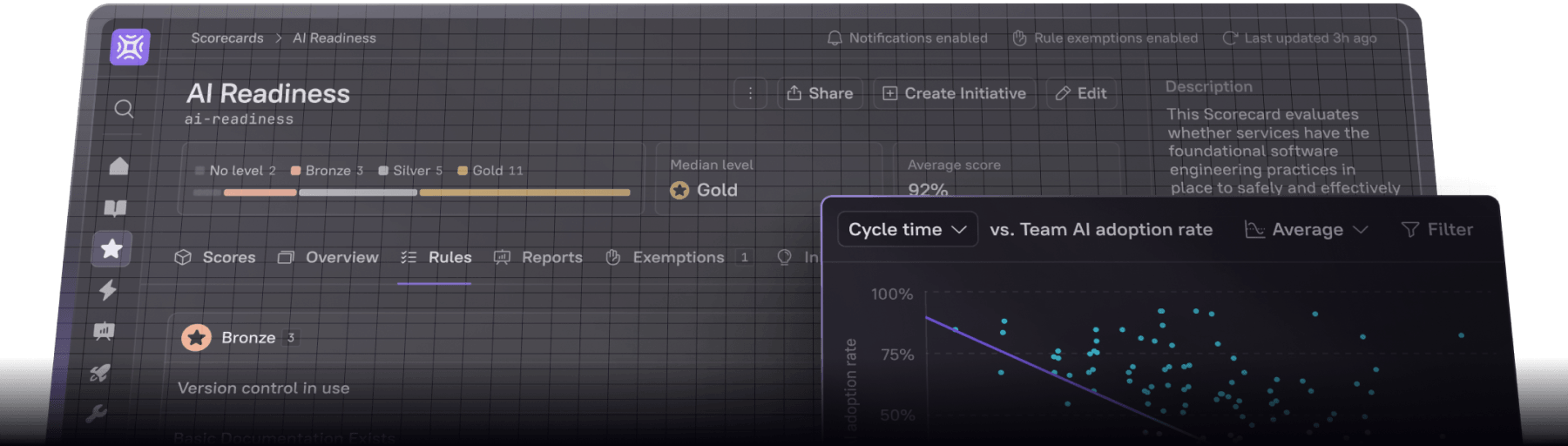
Engineering maturity, the ability to know the state of your systems and standards at any given moment, is what makes speed sustainable. Teams that can answer "what's running, who owns it, and does it meet our standards" whenever the question comes up are the teams that can safely absorb whatever AI produces. Those questions apply to services written by humans and services scaffolded by AI agents alike. Cortex helps engineering organizations get there by tracking every service against automated Scorecards, surfacing where standards are met, slipping, or missing entirely, and giving leaders a real-time picture of production readiness across the entire service catalog, regardless of who or what wrote the code.
The organizations that thrive with AI will be the ones that built the infrastructure to absorb the pace.
See how Cortex helps engineering teams maintain standards and visibility as AI adoption accelerates. Schedule a demo.