
When Nicole Forsgren, Margaret-Anne Storey, and their coauthors published "The SPACE of Developer Productivity" in 2021, they settled an argument the industry had been losing for years. Productivity is not one number, and it is not a proxy like commits or story points. It is multidimensional, and any attempt to flatten it into a single metric will mislead you. Most of what came after in developer productivity measurement builds on SPACE.
SPACE and DRIVE were built for different jobs. SPACE helps you think clearly about developer and team productivity. DRIVE gives you a model for measuring the organization and a cadence for acting on it. Both are useful, and they answer different questions.
The key points:
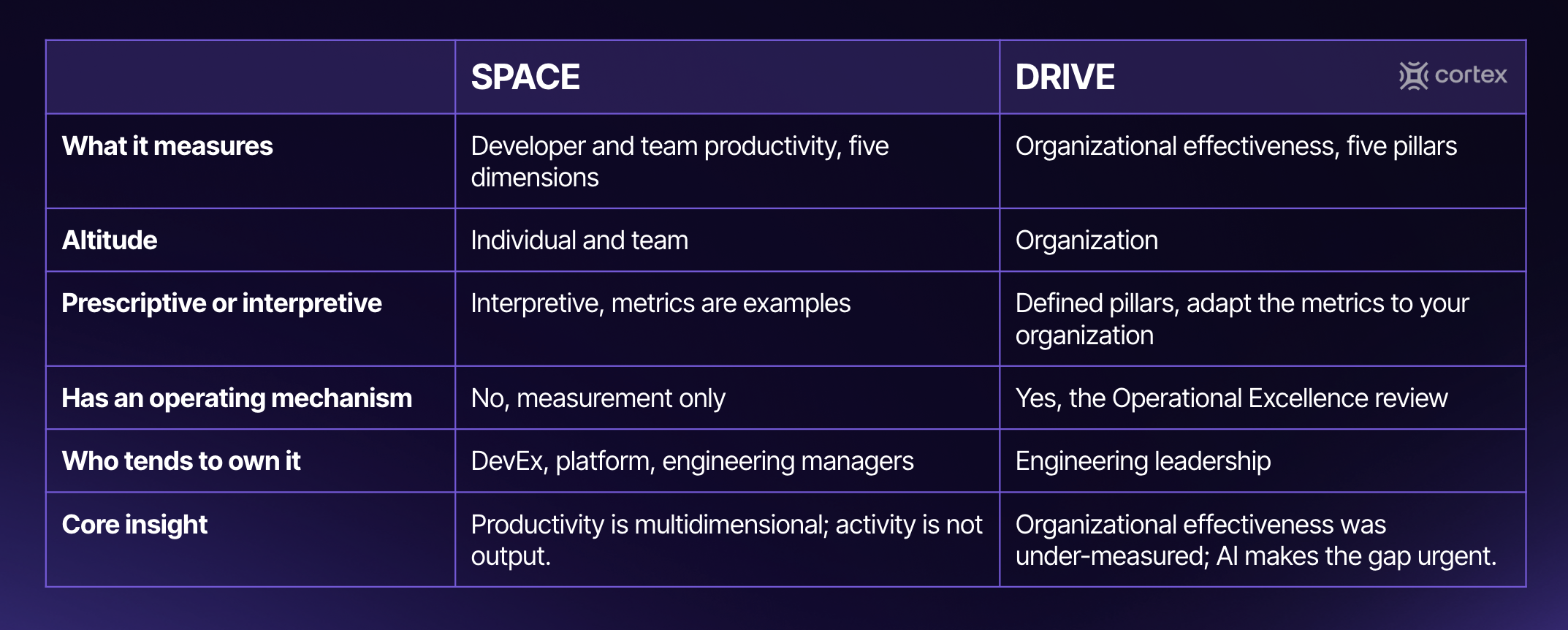
SPACE (Forsgren, Storey et al., 2021) measures developer and team productivity across five dimensions: Satisfaction and well-being, Performance, Activity, Communication and collaboration, and Efficiency and flow.
DRIVE measures organizational effectiveness across five pillars: Delivery, Reliability, Initiatives, Vigilance, and Efficiency, and it folds in DORA's four delivery signals.
The altitude differs. SPACE looks at the individual and the team. DRIVE looks at the organization.
The mechanism differs. SPACE is a measurement lens with no prescribed metrics and no ritual. DRIVE is inseparable from a recurring Operational Excellence review that turns the numbers into reallocated time, people, and budget.
Most enterprise orgs should use both. Use SPACE to design developer-level signals, then roll them into DRIVE's organizational view.
What does DRIVE measure?
DRIVE is a framework for measuring engineering organizational effectiveness in the age of AI. It asks whether the organization as a whole is sustainably turning customer needs into reliable, secure software at a reasonable cost, the core question of engineering operations as a discipline, and it does that across five pillars:
Delivery, the speed and sustainability of shipping, including deploy frequency, lead time, and on-call load.
Reliability, whether you are keeping the promises you made to customers, grounded in functional SLOs and high-severity incidents.
Initiatives, the progress of org-wide non-product work like migrations, platform adoption, and AI governance, the things that stall when nobody at the leadership level is watching.
Vigilance, security posture and risk accumulation, including the new attack surface that AI-generated code opens up faster than teams can track it.
Efficiency, how capacity and spend are allocated between building new things and keeping the lights on, now including token spend as agentic workflows scale.
The pillars are not the whole framework. DRIVE is inseparable from the Operational Excellence review, the recurring leadership ritual, with direct precedent in the ops reviews run at AWS, Stripe, and Google SRE, where teams interrogate the data and reallocate resources against what they find. The metrics tell you where the organization is drifting. The review is what applies the pressure to correct it. A DRIVE scorecard with no review attached is a dashboard nobody acts on.
What does SPACE measure?
SPACE is a model for understanding developer productivity across five dimensions: Satisfaction and well-being, Performance, Activity, Communication and collaboration, and Efficiency and flow. Its central argument is that these dimensions counterbalance one another, so looking at any single one, especially Activity, gives you a distorted picture of how developers and teams are actually doing.
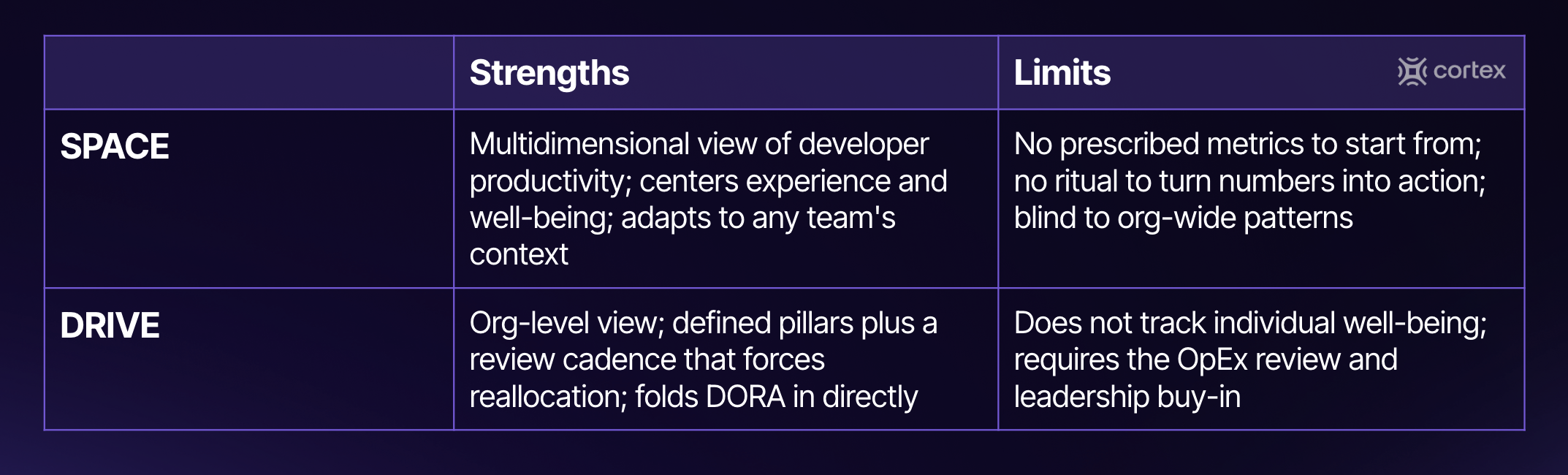
The part most people get wrong is treating SPACE like a metric set. It isn't one. The authors were explicit that the metrics in the paper are examples, not recommendations. SPACE is a lens for thinking critically about what productivity means in your context, then choosing signals that fit. That flexibility is the framework's great strength and also the reason teams struggle with it. SPACE tells you which dimensions deserve attention. It deliberately leaves the "so what do we actually measure, and what do we do about it" to you.
Does DRIVE replace SPACE? No. DRIVE is designed to complement SPACE. SPACE measures developers and teams. DRIVE measures the organization one altitude up, and it folds DORA's four delivery signals into its Delivery and Reliability pillars. It builds on developer-level measurement rather than displacing it.
How are DRIVE and SPACE different?
There are two real differences.
Altitude. SPACE measures the developer and the team: how a person or a squad is doing, how they feel about the work, how effectively they collaborate. DRIVE measures the organization: whether cross-team initiatives are landing, whether risk is concentrating as output accelerates, whether capacity is going to the right problems. When agents write and review a growing share of code, the constraint moves off the individual developer and onto the systems around them, the ownership models, the review gates, the security posture, the operational controls. That organizational layer is exactly what a developer-productivity framework was never designed to see. It is a different atomic unit.
Mechanism. SPACE is a way of thinking about what to measure. It has no opinion about what you then do with the numbers, and it carries no governance ritual. DRIVE does. The Operational Excellence review is not an optional add-on to DRIVE, it is the point of it, the balancing feedback loop that turns measurement into reallocation on a predictable cadence.
SPACE measures something DRIVE does not. Individual satisfaction and well-being sit at the developer altitude by design, and DRIVE does not track them. If your question is burnout, morale, or retention, SPACE or a dedicated developer experience index is the right instrument, and DRIVE is the wrong one.
Strengths and limits of each framework:
When should you use DRIVE vs SPACE?
Reach for SPACE when you are designing a developer-productivity measurement approach and want a principled way to avoid single-metric traps, or when the question is developer experience and well-being. Reach for DRIVE when you need a model for organizational effectiveness and a standing cadence for acting on it.
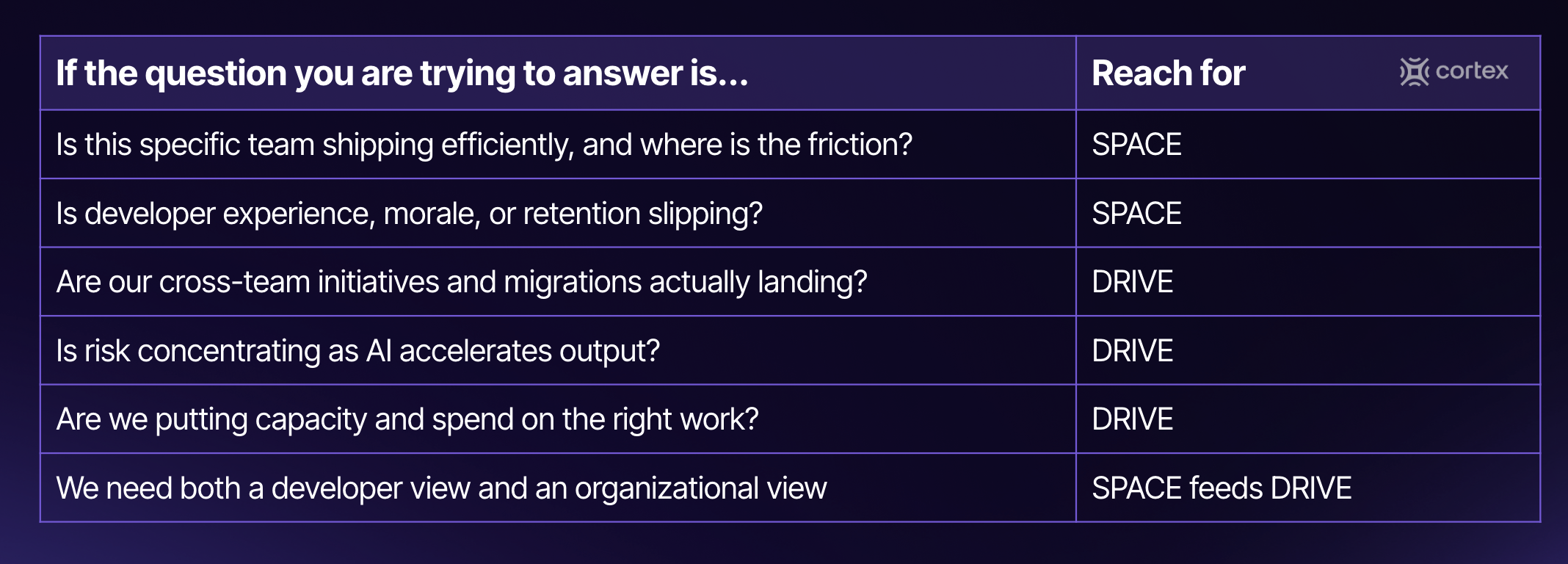
For most organizations at scale, both frameworks should be employed. Use SPACE's dimensions to design sound developer and team-level signals, then let those roll up into the org-level view DRIVE structures.
Where engineering measurement goes next
SPACE warned in 2021 that Activity is not output, that counting volume tells you little about value. Agent-written code has made that warning sharper in the age of AI. When a model produces a large share of the diffs, activity counts say almost nothing, and the real risk (unowned services, expanding attack surface, maintenance drag) shows up at the organizational altitude where Vigilance and Efficiency are pointed.
The question in front of engineering leaders now is not how to make an individual developer five percent better. It is whether the organization can absorb, validate, and operate everything the agents are producing, and keep its promises to customers while it does. That is an organizational question, and it needs an organizational framework with a mechanism attached.
Use SPACE where it is strong, at the developer and team altitude. Use DRIVE to run the organization at its fastest sustainable speed.
See where your organization stands across the five DRIVE pillars and get tailored recommendations at cortex.io/drive/assessment. The full framework, including the OpEx review mechanics, is at cortex.io/report/drive-framework.
Frequently Asked Questions
Does DRIVE replace SPACE?
No. DRIVE is built to complement SPACE and other developer productivity frameworks. SPACE measures developer and team productivity. DRIVE measures organizational effectiveness one altitude up, and it folds DORA's four delivery signals into its Delivery and Reliability pillars.
Is SPACE a prescriptive set of metrics?
No, and this is the most common misread. The authors present specific metrics as examples, not recommendations, and intend the five dimensions as a way to think critically about what productivity means for your teams. Copying the example metrics table verbatim misses the point of the framework.
Can you use SPACE and DRIVE together?
Yes, and most organizations at scale should. Use SPACE's lens to design sound developer and team-level metrics, then let those signals roll up into DRIVE's org-level pillars. SPACE shapes the inputs, DRIVE structures the organizational view and gives leaders a cadence to act on it.
Who owns SPACE and who owns DRIVE?
Developer-level measurement informed by SPACE usually sits with DevEx, platform teams, or engineering managers close to the work. DRIVE sits with engineering leadership, who run the recurring Operational Excellence review that reallocates time, people, and budget against the gaps.
Does SPACE still hold up with AI-generated code?
Its core insight holds up well. SPACE argued in 2021 that activity is not the same as output, and agent-written code makes that truer than ever. The one caution is the Activity dimension: raw volume means less when a model writes much of the code, so the signal that matters shifts up to the organization, where DRIVE's Vigilance and Efficiency pillars track exposure and capacity.