
I've spent a lot of time talking to platform teams who feel like they're running in circles. They build incredible automation to speed up service delivery, but even when it's running perfectly, nobody actually knows what's happening across the organization. It's hard to see who owns which service or if those services even meet basic company standards.
Automation's a great start, but it usually hits a wall when you try to scale it. That's why we’re partnering with Syntasso, the team behind Syntasso Kratix Enterprise (SKE). We wanted to find a way to make platform capabilities visible and measurable without adding more friction for developers.
Orchestration is only as good as your visibility
The way our tools work together is pretty straightforward. SKE handles the heavy lifting of orchestration and lifecycle management. It uses what they call Promises to turn developer intent into actual platform outcomes. These are essentially declarative contracts for services that any team can use.
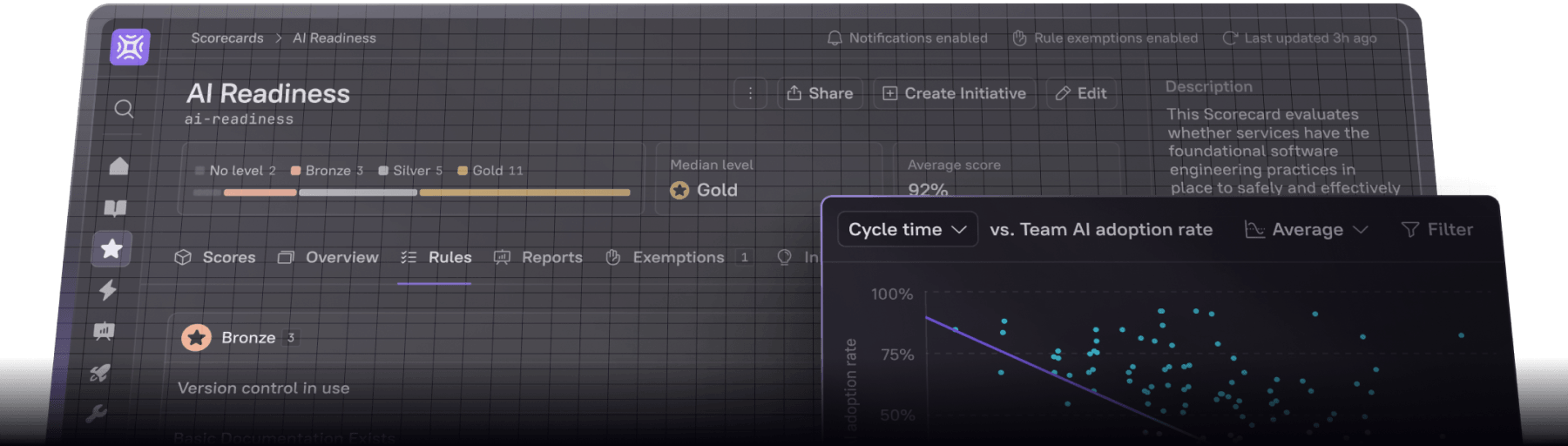
Cortex then acts as the layer that makes everything understandable for the rest of the organization. We pull those Kratix Promises into the Cortex catalog so they become first-class assets. This means you can finally see clear ownership for every API and Workflow. You can also use Scorecards to track how these services are performing and ensure they stay compliant over time.
Solving real platform challenges
We see teams using this combination to solve the platform headaches that usually cause the most friction. "Platform teams don't succeed just by delivering infrastructure," says Syntasso CEO Colin Humphreys. "They succeed when the capabilities they create are understandable, trusted, and adopted." This integration is designed to close that gap, finally bridging the divide between the control platform teams need and the autonomy developers expect.
The self-service internal marketplace
Most platform teams could commiserate over the pain of needing a production-ready database and having to wait days for a ticket to be processed. They don't want to be blockers, but they have to ensure standards are met. By defining these resources as Kratix Promises and surfacing them in Cortex, ticket-taking, as we all know it, becomes a thing of the past, and you end up with a true self-service marketplace.
Developers simply request what they need through a Cortex form. SKE handles the heavy lifting of provisioning in the background, and the resource automatically appears in their Service Catalog, complete with ownership data and Scorecards. It’s the best of both worlds: speed for the developer and control for the platform team.
True multi-cloud abstraction
Asking developers to context-switch between AWS, Azure, and Google Cloud consoles is a recipe for frustration. It also makes it incredibly hard to enforce consistent tagging and security policies. This integration lets you abstract that complexity away entirely.
A developer can just request a generic "Database" through Cortex. SKE handles the logic of provisioning it on the correct cloud provider based on your specific policies, whether that's for data residency, cost, or performance. The developer gets a working resource without needing to know (or care) which cloud it's running on, while you maintain full control over the infrastructure strategy.
Building for an AI-driven future
We're all thinking about how AI's going to change the way we work. It's going to demand even more speed, but that speed usually comes with more risk. If you've got automation without visibility, you're essentially flying blind at 500 miles per hour.
Our work with the Syntasso team focuses on removing that risk. "To move faster with coding agents, it starts with improving your operational maturity and giving teams autonomy with guardrails," says Cortex co-founder and CEO Ganesh Datta. "If you make doing things the right way the easy way, developers and AI agents can operate at speed." With Kratix Promises as the infrastructure engine and Cortex surfacing those capabilities through golden paths and clear visibility, platform teams can deliver on exactly that.
What's next for the partnership
We're just getting started with this collaboration. The initial feedback has been great so far because it finally gives people a clear path to balance fast delivery with actual governance.
You can expect to see more from us soon, including some joint webinars where we'll dive into the technical details. We're really looking forward to seeing what you build with these tools.