
Cortex’s Engineering Excellence Award recognizes the engineers building secure, AI-native SDLCs. Winners are putting AI to work at scale without trading away security, reliability, or efficiency, and they’re showing other teams what good looks like.
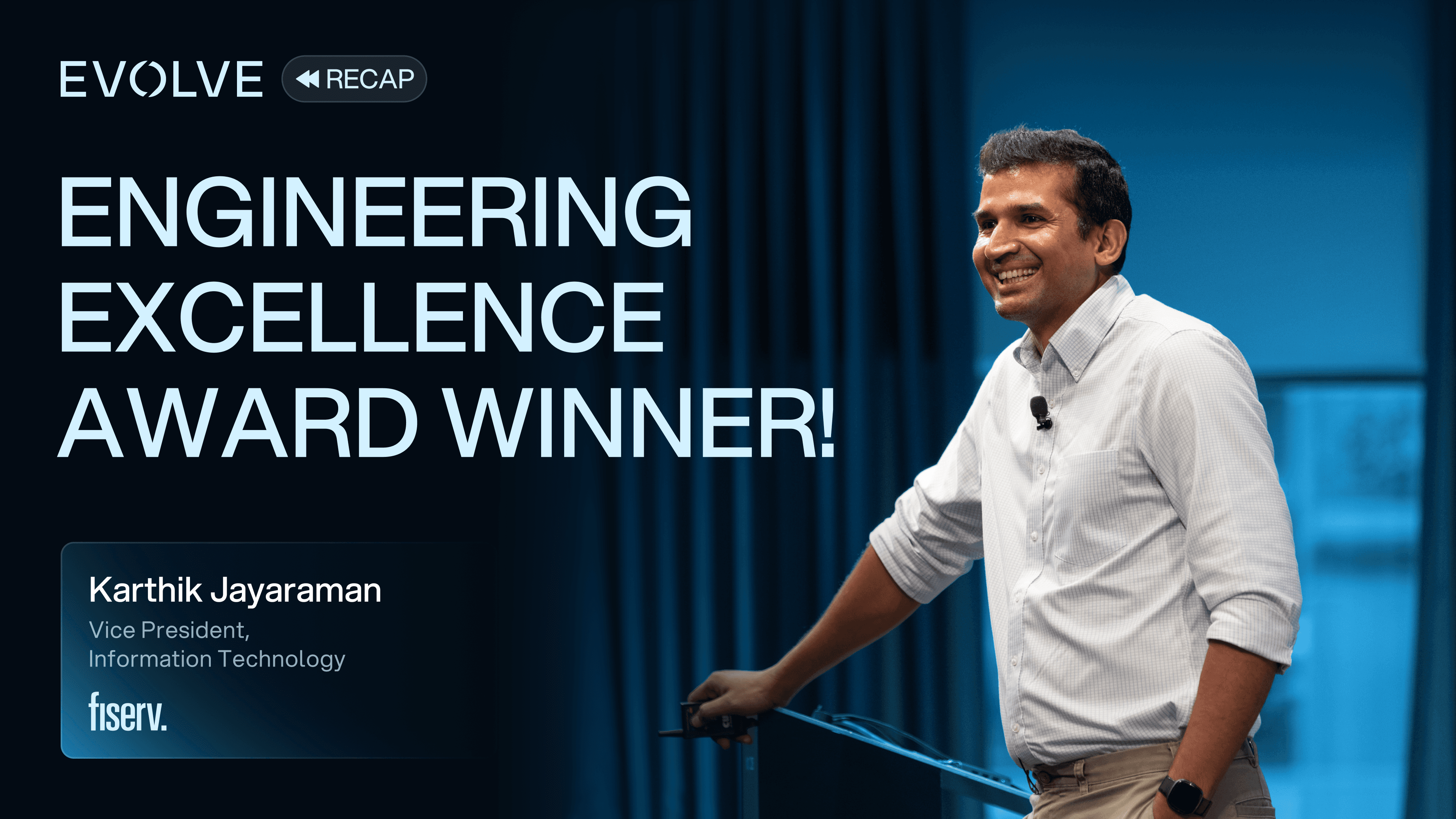
Karthik Jayaraman, Vice President of Information Technology at Fiserv, is a 2026 Engineering Excellence Award winner. His team, Flex DevEx, owns everything a Fiserv developer touches between idea and production. Fiserv grew largely by acquiring companies, and each one brought its own way of building software, so much of Karthik's work is getting those teams onto shared standards.
We sat down with Karthik to talk about why more controls make teams faster, why the AI bottleneck is verification rather than code, and why the best technical solution still loses without trust. The conversation has been edited for length and clarity.
Developer experience should feel like air
Tell us about your role and what your team owns.
I lead developer experience at Fiserv. We call it Flex DevEx, and it covers everything a developer touches to go from idea to production. That could be SCM systems, artifact storage, CI/CD platforms, cloud IDEs, AI. Everything falls under this team.
We started off focused on providing the tools themselves. At this point, it's less about the tools and more about delivering them as a service. What I keep telling people is that developer experience, the whole process from idea to production, should become like the air around us. Developers don't need to see it, but it's there, it's essential, and it's always working for you.
How did you get into engineering?
For me, it’s all about solving problems. Most of the projects in my career have been complex ones that people were perplexed about how to solve.
Take Aadhaar, the resident biometrics system for a billion and a half people [in India]. At the time, the technology could compare two biometrics and give you a percentage match, but you couldn’t search on them. We were building a system that could search across that much data.
Or the national health systems I worked on in Singapore and Australia, where we connected hospitals across the nation. If there’s a flu outbreak, the government immediately knows, based on the symptoms reported across hospitals, where to send vaccinations.
The uniqueness and the impact it creates are what matter to me.
What did engineering at Fiserv look like before you joined, and where was the pain?
Teams working in silos, with their own processes, isn’t unique to Fiserv. What is unique is how we got there. Most of our growth has come from acquiring companies, and that created pockets of teams working independently, with processes that didn’t gel with the rest of the organization. In effect, Fiserv was operating like 20 different companies.
Our team gives those teams a place, a conduit, to work together. It’s less about centralizing and more about standardizing processes and learning from each other. Now that we have a standard way to do things, it’s easier for security and cyber to answer the question of how we’re building software. You couldn’t have answered that 10 years ago, because everyone did it their own way. Now we can say 80% do it this way and 20% do it slightly differently in these ways, and we have a roadmap to get people onto the right way of doing things.
Where have you hit the most resistance rolling out standards?
It’s to do with trust. For those teams, it can feel as if something they owned is moving out of their control, and now they have to make more hops to get the same things done.
I’ve always thought about it this way: centralizing or standardizing doesn’t mean loss of control. You’re centralizing the process. You’re making the right way the easy way, but you’re also giving development teams all the controls so they can do what they need to do.
It’s very hard to explain that to people, though. I’m a person of action rather than a person of words. Once you build something, and people can see it and start using it, that’s when they realize the value and start to trust it more.
Building that trust is a journey, and it means being transparent: this isn’t perfect, and we’re going to work toward making it perfect together, rather than you working in your silo. Now you have a support system as you go, and we can replicate that across Fiserv.
More controls lead to faster development
How fast you can drive your car depends on how good your brakes are.
What's a belief about running engineering that your peers might disagree with?
Something I always say is how fast you can drive your car depends on how good your brakes are. If you don’t have good brakes, you’ll be very careful and go slow, because you know that when something goes wrong, you can’t stop.
In the same way, I see controls as a way that will make you go faster, not slower. I think most of my peers would say that having more and more controls, whether security, cyber, or anything else, will slow development down. With more controls, you have more trust in the process. You know there are belts and suspenders in there that will save you or break your fall when you go fast.
That doesn’t mean controls that become a bottleneck. You also want to remove friction, with automated controls evaluated against policies, policy as code.
What do you refuse to compromise on under pressure?
I will never compromise on security or any of the engineering controls in place.
That said, wherever we have controls, there are always break-glass scenarios, where people say they’ll get approval from the CEO or someone else. That’s okay when it’s an exception, a once-in-a-lifetime kind of thing. When it happens again and again, something is wrong with your process or with your control. I would rather stop the deployment and pull the andon cord than add risk to our production systems.
You also have a background in law. How did you get into it, and how has it shaped your work as an engineer?
One of the main reasons I wanted to learn law was to give back to the community. To get justice, you need money, and not everyone has that money. There’s also a difference between what people think the law is and what the law really is. Just talking to them about it is a big thing.
Law and IT aren’t that different at all. In IT, when you’re solving a problem, you say, this is the cost to solve it, and if I don’t, this is the punishment. My system breaks and I lose my client. Corporate law is exactly that balance. If a regulator tells me to fix this control, it will cost this much. If I don’t, here’s the probability I get sued, and here’s what that would cost. That balancing act is what drives people to act, in IT and in the legal world.
The bottleneck moved to verification
How has the job of engineering changed in the last two years?
I've been a developer and coded all my life, and as the problems got bigger, I grew into an engineering leader solving bigger problems. But the core remains the same: finding the simplest solution for a complex problem. Problems change, but that's the underlying thing.
With AI, dev teams and AI now need to work together to build, and building isn’t only writing code. Anyone can create code. My EVOLVE talk was about how the bottleneck is in verification.
After the talk, someone gave me an interesting perspective. It isn’t only verification, but the feedback loop back, where AI learns from the verification steps so the next verification passes. That’s what happens with humans. We go through a checklist for verification and code quality, and the next time I write code, I’m already incorporating all of it. We need AI to learn that way too.
The big change is that we’re trying to teach AI what we’ve been doing as part of the development process for a long time. Same problem, different actor, or a combination of actors.
Where else are organizations getting the transition to AI wrong?
When I talk to other organizations, everyone is over-indexing on writing code. Even tools that talk about going end to end are still focused on writing code. Even vulnerability remediation tools are focused on writing code.
People don't understand the verification part. Or when they do understand that verification is the bottleneck, the way they handle it is incorrect in a lot of ways. For example, say unit testing is part of your verification step. I know a team that said, we're going to have 100% test coverage. Then they [had AI write] unit tests from the code that was already written. That doesn't make sense. A unit test written from the code will make sure the code passes every time. It won't make sure the code matches the requirements.
Organizations are missing the crux of what they’re doing. They use unit test coverage as a measure and try to get the measure right, but they miss the reasoning behind it. They still have the same incidents in production even though their code coverage is 100%.
Everything should tie back to cost or revenue
People don’t use something just because it’s the perfect technical solution. They use it because they trust it.
What ritual or habit keeps you effective?
One thing I've tried to drive with my team is outcomes. When I talk to them, I don't ask what they're doing. I ask what the outcome is. Why are you doing this? How is it going to help? What specific outcome are we going to get, and how are we going to measure whether it's successful?
Any business has only two outcomes: cost and revenue. You could say you're doing something to improve security. You're doing it to reduce the cost of a breach. You spend maybe a million so you don't pay $5 million when someone sues you.
Once we tie everything to those two things, I have a team that can think like leaders, because that's what the management council and the CEO are thinking about. It also makes it easier for them to see the right approach. If reducing cost is the outcome and there are multiple solutions, they'll go with the most cost-effective one.
What did you get wrong as a leader that reshaped how you operate?
Many things, but one main one: I used to think that if you had a very strong technical solution, people would use it.
I was once moving bank tellers from mainframes and green screens to a more distributed, modern way of doing things, with screens and a mouse. It failed. The tellers were so used to the green screen that they knew pressing 5641 took them straight to the withdrawal form. That was fast for them. Moving the mouse was slow, and clicking through to the withdrawal screen was slowing them down. That’s the technically sound, modern solution in isolation. Applied to a specific context, it’s different.
People don't use something just because it's the perfect technical solution. They use it because they trust it. Especially with development and deployment processes, they trust someone who will be with them when there's a problem in production. There's a human aspect to it. So the relationship is as important as the technical solution, if not more.
Do you have advice for people who struggle to bring that human element into their work?
I’m an introvert by default. I could sit alone somewhere for a very long time and not speak to anyone. That would be my nirvana state. But we’re all social beings, and there’s a need to cultivate it.
Typically, the reason someone focuses only on the technical solution and skips the conversation is perception. They don’t know what the other person thinks. Take that out of the equation altogether. Have the conversation, be open to the feedback, and be able to change based on it.
I knew my weaknesses, and I knew these are skills that can be acquired. I was a consultant for more than a decade, and in the consulting world we have a lot of tools for this, like mapping a sphere of influence. You map out who’s shaping the decision, identify the person who will make or break it, and focus your attention and energy there. Some people have these skills by default. Others, like me, have to learn them along the way. Once you apply them again and again, it becomes normal.
--
Have an engineer you'd like to nominate for the Engineering Excellence Award? Submit a nomination here.