

Key Results
97.5% reduction in time to deploy services
8X increase in the number of services meeting Tala's required tech maturity standards
100% of services with security testing built into the deployment process
80% increase in teams' ability to self-service, cutting the manual intervention cloud engineering had to provide
The Challenge
Reliability is not negotiable when you are lending money and handling people's private financial data across emerging markets. That was the bar Tala's engineering organization held itself to. The harder part was proving it consistently across more than 100 engineers and ten teams.
Before Cortex, production readiness lived in a spreadsheet. Tala's program team maintained roughly 40 tech maturity practices spanning build and test, code quality, release, operate, and optimize. Once a quarter, the team walked each squad through a 60-minute questionnaire and asked engineers to self-assess against every practice. It surfaced gaps, but it was slow, subjective, and invisible between reviews. Keeping it running had become work in itself. Stefanie Rubin, VP of Program Management, layered in macros and data pools to hold it together, and as the team put it, maintaining all of it was “a job in and of itself."
The stakes shifted when leadership set a mandate to expand into five new markets. Standardization, reliability, and scalability went from good hygiene nice-to-haves to hard prerequisites for the company's next chapter. A quarterly spreadsheet could not move fast enough to support that.
The Solution
Tala's goal was to replace subjective self-assessment with measurement pulled straight from the tools engineers already used. With Cortex, the team wired Scorecards into GitHub, Jenkins, and their other systems so maturity was scored in near real time rather than reconstructed once a quarter. The engineering team trimmed the original 41 practices to around 30 and added measures that reflected how Tala actually worked, including its strong inner-sourcing culture.
The rollout was deliberately small at first. The team set out to define the right metrics, then brought in an initial set of 12 microservices before going wider. An early worry was that scoring could feel like surveillance, so instead of imposing standards top-down, the team ran focus groups where engineers defined what "good" looked like in each area. That decision changed the dynamic: the process was democratized and engineers started proposing their own measures.
Two things sustained momentum. A leaderboard turned progress into healthy competition, and skeptical senior leaders shifted their stance once they saw their teams' scores in the open. In parallel, Rubin pulled a progress view every two weeks, matched to Tala's sprint cycle, to keep executives bought in as services moved from red to green. A separate security Scorecard tracked automated scanning alongside the tech maturity work.
The Results
Over the course of the rollout, Tala reduced the time to deploy services by 97.5%, starting from a baseline Rubin described as "single digits" on many measures, with nearly everything red. By the end of the first quarter on Cortex, the same board was mostly green.
By the end of the initiative last fall, the results were staggering.
8X increase in the number of services meeting Tala's required tech maturity standards.
100% of services received security testing built into the deployment process.
98% carried the technical and business documentation other teams need to self-serve.
81% of services ran automated acceptance tests on pull requests.
Automation produced an 80% increase in teams' ability to self-service, cutting the hands-on intervention the cloud engineering team used to provide.
"There was a period of time where we were having engineers ask, can I have the auto refresh so I can refresh this myself? Because I want to see the impact of my changes."
- Stefanie Rubin, VP of Program Management, Tala
Once rollbacks and outages were systemically measured, they became things engineers worked to eliminate. The surveillance backlash they braced for never arrived.
Engineering excellence stopped being a line item the program team had to defend, since Rubin no longer had to ask teams to reserve capacity each sprint for tech maturity work. Once every engineer could see their own services' scores, improvement became continuous and self-directed. A second-order effect the team did not anticipate: talent density. Standardizing on shared practices, from structured logging to custom metrics, leveled up the whole team's craft.
Production readiness at Tala was a habit engineers owned, not a review they endured once a quarter. The spreadsheet asked people to describe their work; the Scorecards let them see it every day and act on it themselves. That shift, from measuring after the fact to measuring in the loop, is what enabled a 120-engineer org to raise its bar while scaling into five new markets.
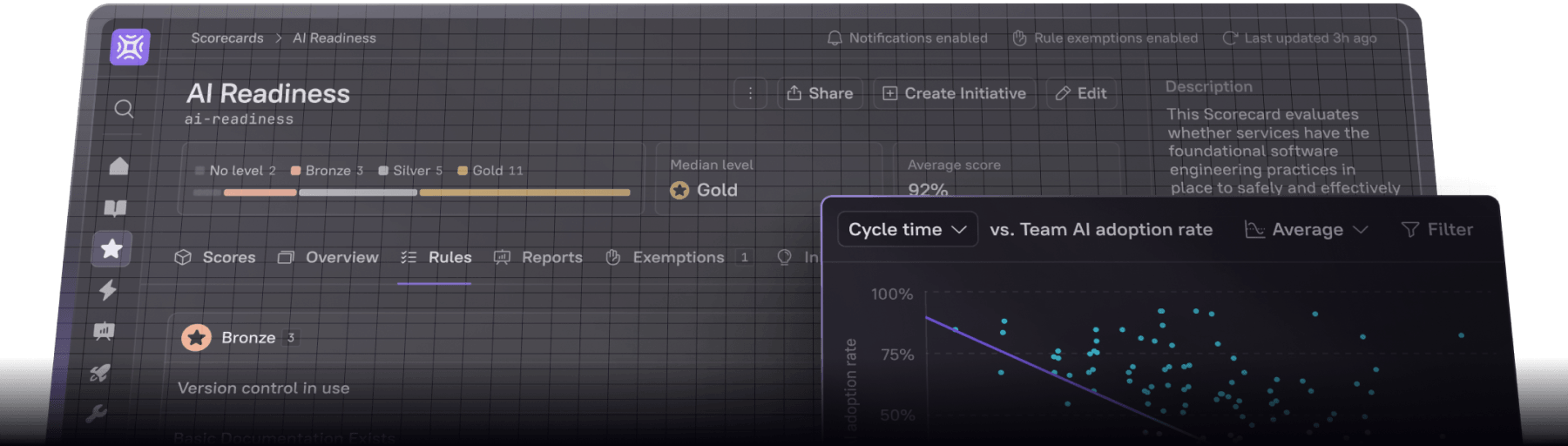
Tala is now applying the same approach to a harder question: how to measure whether AI-assisted code is helping or quietly adding risk. The team has started treating AI as a contributor within the code base, scoring repos for AI readiness the way they once scored them for test coverage. The instinct is the same one that got them here. Decide what good looks like, then measure it where the work happens.
Watch the recording here to learn more about the rollout in full, including a live look at their Cortex environment, on the Production Readiness with Tala webinar.